
Looking for a business growth consultant? Improve profitability, EBITDA, productivity and cash flow through practical business performance strategies.
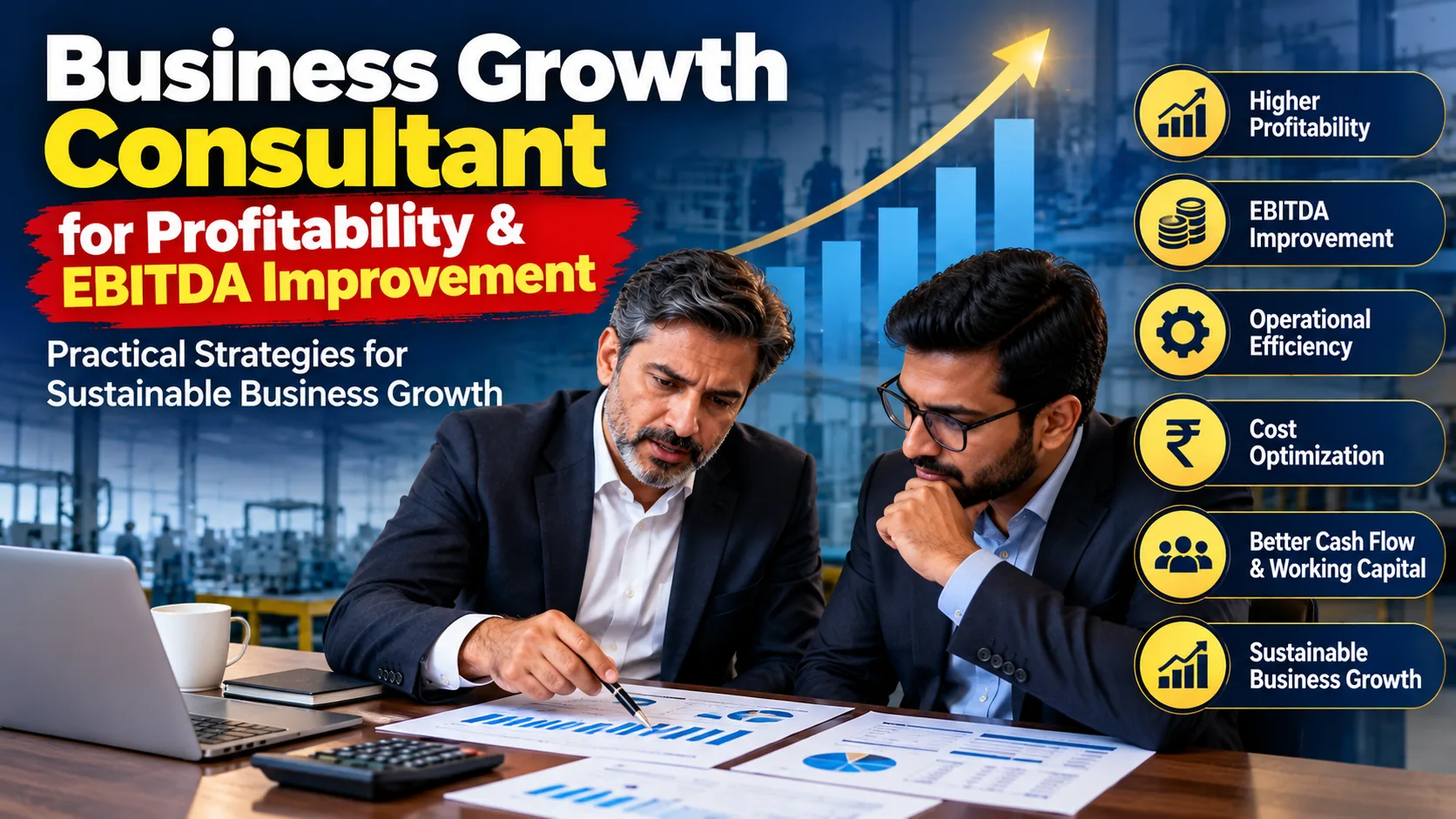
Your business is growing. Revenue is increasing, customers are placing orders, and your team is working harder than ever. Yet, despite this growth, profits may not be improving at the same rate.
Operating costs are rising. Cash flow remains tight. Working capital requirements are increasing. Management spends more time resolving operational problems, but the financial results do not reflect the effort being invested in the business.
This is where a business growth consultant can make a difference—not simply by helping your company grow, but by identifying how to make that growth more profitable, cash-generative and sustainable.
For CEOs, MDs and business owners, the real question is not just how to increase revenue. It is how to convert existing resources, customer relationships, production capacity and business opportunities into better financial results.
A structured approach to business growth can help identify hidden profit opportunities, strengthen operating performance, improve EBITDA and establish clearer accountability for results.
This article explains what a business growth consultant does, how profitability and EBITDA improvement fit into a growth strategy, and how to implement a practical 6–9 month business performance improvement programme.
What Does a Business Growth Consultant Do?
A business growth consultant helps business leaders identify opportunities to improve performance, strengthen profitability and build a more effective operating model.
Unlike a narrow focus on sales or marketing, a comprehensive business growth approach examines the financial and operational factors that determine whether growth creates value.
Depending on the company’s needs, this may involve:
Identifying opportunities to increase EBITDA and operating margins
Improving pricing, product mix and customer profitability
Reducing avoidable operating costs and material waste
Improving productivity and utilization of existing resources
Strengthening working capital and cash-flow management
Improving project execution and cost control
Establishing performance indicators and management accountability
Prioritizing improvement initiatives based on financial impact
A business growth consultant does not simply recommend increasing sales. The objective is to understand what is preventing the business from achieving better results and develop practical actions to address those constraints.
For a manufacturing company, this might mean improving production yield, reducing downtime or correcting pricing errors. For an EPC business, it might mean strengthening project cost control, reducing delays in billing and protecting project margins.
The right priorities depend on the company’s financial position, industry, operating model and growth objectives.
Why Revenue Growth Does Not Always Improve Profitability
Many companies assume that higher revenue will automatically produce higher profits. In practice, growth can create additional costs and operational complexity.
Consider a hypothetical business with the following annual financial performance.
| Financial measure | Before growth | After growth |
|---|---|---|
| Revenue | ₹100 crore | ₹120 crore |
| EBITDA | ₹10 crore | ₹10.8 crore |
| EBITDA margin | 10% | 9% |
Revenue has increased by 20%, but EBITDA has increased by only 8%. The EBITDA margin has declined from 10% to 9%.
The company is larger, but the additional revenue has not translated into proportional profit improvement.
This may happen because of:
Discounts introduced to win additional business
Higher material, labour and logistics costs
Poor project or order profitability
Increased overheads and management complexity
Low productivity and capacity constraints
Higher warranty, rework or delivery costs
Increased working capital requirements
These are illustrative figures, not industry benchmarks.
A business growth consultant examines the reasons behind this gap and helps management identify which changes could improve the financial outcome of growth.
7 Ways a Business Growth Consultant Can Improve EBITDA
EBITDA—earnings before interest, taxes, depreciation and amortization—is commonly used to evaluate operating performance. It is useful, but it should be considered alongside cash flow, working capital, capital expenditure and other relevant financial measures.
1. Identify Hidden Profit Leakage
Profit leakage can occur in many parts of a business without appearing as a separate expense in management reports.
Examples include excess material consumption, avoidable overtime, production downtime, rework, excessive freight, unprofitable orders and discounts that are not supported by cost analysis.
A business growth consultant can help management investigate these issues systematically.
The process typically involves:
Establishing a reliable financial and operational baseline.
Identifying significant variances from budgets or validated standards.
Investigating the underlying causes.
Quantifying the potential financial impact.
Prioritizing improvements according to feasibility and value.
The objective is not to cut every expense. It is to distinguish necessary spending from avoidable costs and inefficient use of resources.
2. Improve Pricing and Customer Profitability
A company can generate substantial revenue from customers who contribute relatively little profit.
Frequent discounts, small production batches, customized requirements, urgent deliveries, extended payment terms and after-sales support can increase the cost of serving particular customers.
A profitability review should examine margins by product, customer, order or business unit where the available data supports reliable analysis.
Possible actions include revising commercial terms, improving quotation methods, reviewing minimum order quantities, changing the product mix or renegotiating prices when justified.
A business growth consultant helps management evaluate these opportunities without automatically sacrificing important customer relationships.
The key question: Which customers and products create the greatest contribution after considering the resources and costs required to serve them?
3. Improve Operational Productivity
Businesses sometimes invest in additional machinery, facilities or employees before fully utilizing their existing resources.
However, underutilized capacity, inefficient workflows, long changeovers, poor scheduling and recurring bottlenecks can prevent current resources from delivering their full potential.
A productivity improvement programme may examine:
Output per employee or labour hour
Machine availability and utilization
Production cycle times
Material yield and scrap
Rework and quality failures
Production planning and schedule adherence
The appropriate measures vary by industry. Productivity should be evaluated alongside product quality, customer demand, safety and operating constraints.
For manufacturers, better productivity can reduce unit costs or enable additional profitable output. For project-driven businesses, improved resource planning and execution can help reduce avoidable delays and cost overruns.
Explore ProfitEdge Consulting’s EPC performance improvement services if project execution and profitability are important challenges in your business.
4. Strengthen Cost Control and Budget Accountability
Budgets alone do not improve business performance. Management needs timely information about why actual results differ from expectations and who is responsible for corrective action.
Weak cost controls can allow small variances to continue until they become significant financial problems.
A stronger performance management system can include:
Monthly financial and operating reviews
Department-wise cost and performance indicators
Clear ownership of significant variances
Corrective action plans with deadlines
Forecasts that reflect current operating conditions
Verification of realized savings
A business growth consultant can help establish a consistent review process that connects financial outcomes with operational drivers.
For example, if gross margin declines, management should investigate pricing, material consumption, product mix, productivity and quality costs rather than simply instructing every department to reduce spending.
5. Improve Working Capital and Cash Flow
A profitable company can still experience cash shortages.
Inventory may accumulate faster than sales. Customers may pay late. Work may be completed before it can be billed. Supplier payments may fall due before customer collections arrive.
These problems are especially important for manufacturing, EPC, infrastructure and other project-driven businesses.
A working-capital review may examine:
Inventory ageing and stock turnover
Outstanding receivables and overdue invoices
Unbilled revenue and billing delays
Supplier payment terms
Cash-flow forecasting
The relationship between growth and funding requirements
A business growth consultant can help management identify ways to release cash from inefficient processes and improve cash-flow visibility.
However, cash released through inventory or receivables improvements is not automatically an EBITDA improvement. Profitability and cash flow must be measured separately.
6. Improve Project and Order Profitability
For EPC companies, engineering businesses and manufacturers handling customized orders, profitability can be determined long before the final invoice is raised.
An order may appear attractive when it is awarded but become less profitable because of underestimated costs, scope changes, delayed approvals, rework, poor subcontractor performance or schedule slippage.
Management should compare actual and forecast costs with the original estimate and approved changes throughout execution.
Important measures may include:
Estimated cost to complete
Actual cost against budget
Project gross margin
Schedule variance
Unapproved variations and claims
Billing milestones and collection status
A structured review can help management identify deteriorating margins early enough to consider corrective action.
For companies facing project overruns or execution difficulties, ProfitEdge’s Project Recovery Services provide a relevant starting point for exploring project performance challenges.
7. Establish a Practical Business Improvement Roadmap
Businesses often have more improvement ideas than they can implement effectively.
Without clear priorities, teams may begin multiple initiatives without adequately measuring their value or assigning accountability.
An effective improvement roadmap should distinguish between immediate corrective actions, medium-term operational changes and longer-term strategic investments.
Each initiative should have:
A clearly defined problem
A financial or operational baseline
A realistic improvement target
An accountable owner
Required resources and milestones
A method to verify the result
A business growth consultant can help management prioritize initiatives by expected value, implementation difficulty, risk and time to benefit.
This creates a more disciplined approach than pursuing disconnected cost-cutting exercises or growth projects.
Business Growth Strategy: Revenue, EBITDA and Cash Flow Must Work Together
Sustainable growth requires more than a single financial target.
A business may increase sales while its margins deteriorate. It may improve EBITDA while cash flow remains weak. It may release working capital while failing to improve underlying operating performance.
A useful business growth framework therefore considers several dimensions together.
| Performance area | What management should examine |
|---|---|
| Revenue quality | Growth by product, customer and business unit |
| Profitability | Gross margin, EBITDA and contribution |
| Cost efficiency | Material, labour, overhead and operating costs |
| Productivity | Output, capacity utilization and quality |
| Working capital | Inventory, receivables and payables |
| Execution | Delivery performance, project costs and accountability |
The purpose is to understand how these areas influence one another.
For example, accepting a low-margin order may increase revenue but consume scarce production capacity. Producing additional inventory may improve reported output while tying up cash. Cutting maintenance expenditure may reduce costs temporarily but increase breakdowns later.
The best growth decisions consider the total business impact rather than optimizing one metric in isolation.
A 6–9 Month Business Growth and EBITDA Improvement Roadmap
Sustainable business performance improvement requires more than a short diagnostic exercise. It involves identifying opportunities, validating their financial impact, implementing changes and ensuring that results are maintained.
A 6–9 month programme provides a practical framework for moving from diagnosis to implementation and sustained performance review. The actual timeline depends on the company’s size, data quality, operating complexity and management capacity.
Phase 1: Months 1–2 — Business Performance Diagnostic
Objective: Establish the baseline and identify the highest-priority opportunities.
The first phase develops a fact-based view of the company’s financial and operational performance.
Key activities:
Review revenue, gross margin, EBITDA and operating costs.
Analyze product, customer, project or business-unit profitability where data is available.
Examine material consumption, productivity, downtime and quality losses.
Review inventory, receivables, payables and cash-flow patterns.
Interview key functional leaders and investigate major performance gaps.
Identify risks, constraints and potential improvement opportunities.
Deliverables:
Business performance baseline
Prioritized opportunity register
Initial estimates of potential financial impact
Agreed performance indicators
Management-approved improvement priorities
Potential savings should be treated as hypotheses until they have been validated against reliable data and operating conditions.
Phase 2: Months 2–3 — Opportunity Validation and Action Planning
Objective: Convert initial findings into a realistic improvement plan.
Not every identified opportunity can or should be implemented immediately. Management must assess feasibility, investment requirements, operational risks and the time needed to realize benefits.
Key activities:
Validate the root causes of significant performance gaps.
Quantify the expected financial and operational impact.
Estimate implementation costs and resource requirements.
Prioritize initiatives by value, feasibility and urgency.
Assign accountable owners and implementation milestones.
Establish a process to measure and verify results.
Deliverables:
Approved improvement roadmap
Defined initiative owners and responsibilities
Baselines and targets for key performance indicators
Implementation schedules and review arrangements
At this stage, the company should know which opportunities deserve immediate action, which require investment and which need further investigation.
Phase 3: Months 3–5 — Implement Priority Improvements
Objective: Deliver early results while building implementation discipline.
The initial implementation phase should focus on high-priority opportunities that can be addressed without compromising safety, quality, customer commitments or long-term capability.
Depending on the business, initiatives may include:
Reducing material waste and rework
Improving purchasing controls and supplier performance
Correcting pricing and quotation weaknesses
Improving production scheduling and equipment reliability
Resolving project cost-control issues
Reducing avoidable inventory and billing delays
Improving accountability for departmental cost variances
Deliverables:
Implemented corrective actions
Documented operational improvements
Early evidence of financial benefits
Updated performance dashboards
Escalation of issues requiring management decisions
Benefits should be measured against an agreed baseline. One-time savings, recurring cost reductions, additional contribution and working-capital release should be reported separately.
Phase 4: Months 5–7 — Extend Improvements and Strengthen Controls
Objective: Expand successful initiatives and address deeper operational constraints.
After early improvements have been tested, management can extend effective practices to other departments, product lines, projects or facilities where appropriate.
Key activities:
Replicate successful practices across comparable operations.
Address bottlenecks that require cross-functional coordination.
Strengthen forecasting, budgeting and cost-control processes.
Improve product, customer or project profitability reviews.
Review progress against financial and operational targets.
Correct implementation gaps and revise actions where evidence warrants it.
Deliverables:
Wider adoption of successful initiatives
Improved management reporting and accountability
Revised forecasts based on actual results
A clearer view of recurring versus one-time benefits
The aim is to ensure that improvements are not isolated successes but become part of the normal operating system.
Phase 5: Months 7–9 — Sustain Results and Build the Next Growth Plan
Objective: Embed performance improvements and prepare for the next stage of growth.
The final phase focuses on ensuring that improvements are maintained and that the business is better prepared to grow profitably.
Key activities:
Verify realized financial benefits against the baseline.
Review whether operational improvements are sustained.
Incorporate effective controls into budgets and standard procedures.
Assess the remaining improvement opportunities.
Evaluate capacity, investment and working-capital needs for growth.
Develop the next phase of business performance priorities.
Deliverables:
Verified improvement results
Updated operating procedures and management controls
Ongoing performance review dashboard
Remaining opportunity pipeline
Next-stage business growth and EBITDA improvement plan
A 6–9 month programme does not guarantee a specific increase in EBITDA. Results depend on the starting position, opportunity size, implementation quality, market conditions and management execution.
Summary of the 6–9 Month Roadmap
| Timeline | Primary focus | Expected output |
|---|---|---|
| Months 1–2 | Diagnostic | Baseline and prioritized opportunities |
| Months 2–3 | Validation and planning | Approved action plan and targets |
| Months 3–5 | Priority implementation | Early verified improvements |
| Months 5–7 | Expansion and control | Broader adoption and stronger controls |
| Months 7–9 | Sustainability and next plan | Verified results and ongoing improvement system |
Some phases may overlap. The programme should be adapted to the business rather than followed as a rigid timetable.
How to Measure Progress During the Programme
A business growth consultant should help management measure performance throughout the engagement, not just at the end.
Relevant indicators may include:
| Performance area | Example indicators |
|---|---|
| Profitability | EBITDA, EBITDA margin, gross margin |
| Cost efficiency | Material cost per unit, overhead variances |
| Productivity | Saleable output per labour hour, downtime |
| Quality | Scrap, rework, first-pass yield |
| Working capital | Inventory days, receivable days, overdue invoices |
| Projects | Cost to complete, margin variance, schedule performance |
| Execution | Milestones completed, corrective actions closed |
Use measures that fit the business model and available data. Establish definitions and baselines before setting targets.
Management should also distinguish between projected benefits, implemented improvements and financial results that have actually been verified.
When Should You Hire a Business Growth Consultant?
Not every business requires external consulting. However, an independent review may be useful when management faces persistent performance problems or cannot clearly identify the main constraints to profitable growth.
Consider a business growth consultant if:
Revenue is growing but EBITDA margins are declining.
Costs are increasing faster than sales.
Management cannot explain significant financial variances.
Profitability differs widely across products, customers or projects.
Working capital requirements are rising sharply.
Improvement initiatives are not delivering measurable results.
Project overruns and delayed collections are affecting cash flow.
Management needs an independent view of business performance.
The value of an external consultant depends on the relevance of the analysis, the quality of available data, management commitment and the practicality of the recommendations.
Before engaging a consultant, clarify the expected deliverables, scope, responsibilities, confidentiality arrangements and how improvement results will be measured.
How to Choose the Right Business Growth Consultant
The right consultant should understand the relationship between strategy, operations and financial performance.
Before making a decision, consider the following.
Industry and operating experience
Does the consultant understand your business model, industry economics, operational constraints and commercial risks?
Financial and operational analysis
Can the consultant connect revenue, costs, EBITDA, productivity and working capital rather than examining each area in isolation?
Practical recommendations
Will the engagement produce specific priorities, owners, timelines and measurable outcomes rather than a generic strategy report?
Management collaboration
Can the consultant work with your leadership team and functional heads to understand the real causes of underperformance?
Clear measurement
Are the baseline, assumptions, implementation costs and method of verifying results defined before benefits are claimed?
The aim is to select a partner who can help your management team make better decisions and turn identified opportunities into sustainable improvements.
Discover Your Business’s Untapped Profit Potential
At ProfitEdge Consulting, the focus is on helping business leaders examine performance gaps and identify opportunities to improve profitability, cost efficiency, productivity and working capital.
The Executive Business Performance Assessment provides a starting point for exploring potential improvement areas relevant to your business.
If you are a CEO, MD, CFO or business owner, ask yourself:
Is our revenue growth translating into stronger EBITDA?
Do we understand the largest sources of cost and margin leakage?
Are our products, customers and projects generating adequate returns?
Is working capital restricting our ability to grow?
Do we have a clear, accountable plan to improve performance?
If these questions are difficult to answer confidently, your next step may be to assess business performance before committing more resources to growth.
Explore the Executive Business Performance Assessment (Free)
You can also learn more about ProfitEdge Consulting or contact our team to discuss your business’s profitability and growth challenges.
Frequently Asked Questions
1. What is a business growth consultant?
A business growth consultant helps companies identify and address constraints to sustainable growth. Depending on the engagement, this may include profitability, EBITDA, pricing, productivity, cost control, working capital and management execution.
2. How can a business growth consultant improve EBITDA?
A consultant may identify opportunities to improve pricing, reduce avoidable costs, increase productivity, improve product and customer profitability, and strengthen operational execution. Actual results depend on the company’s circumstances and implementation.
3. Is business growth consulting only for large companies?
No. Businesses of different sizes may benefit when they face meaningful performance challenges, provided the scope of the engagement is appropriate to their needs, resources and complexity.
4. Why can revenue grow while EBITDA margins decline?
Revenue growth can bring additional costs, discounts, operational complexity and working-capital requirements. If these costs increase faster than the contribution from additional sales, EBITDA margins can decline.
5. How long does a business growth improvement programme take?
The timeline depends on the company’s size, complexity, data quality and the scale of the changes required. A 6–9 month programme can provide a structured framework for diagnosis, implementation and sustainability, but some improvements may take longer.
6. Can EBITDA improve without increasing revenue?
Yes. Depending on the business, improvements in pricing discipline, material yield, productivity, quality, procurement or overhead efficiency can improve EBITDA without increasing revenue. The opportunity must be validated against actual operating and financial data.
7. How is EBITDA improvement different from cash-flow improvement?
EBITDA reflects operating earnings before interest, taxes, depreciation and amortization. Cash flow also reflects working-capital movements, capital expenditure, financing and other cash transactions. A business can improve one without seeing an equivalent immediate improvement in the other.
About the Author
Vipin Gandhi — Founder & Principal Consultant, ProfitEdge Consulting
Vipin Gandhi brings 35+ years of industry and consulting experience, with a focus on business performance improvement, profitability, cost optimization and operational efficiency. His experience includes industrial, engineering and project-driven environments.
Learn more about ProfitEdge Consulting.
Is Your Business Realising Its Full Profit Potential?
Discover potential gaps in profitability, EBITDA, productivity and working capital with our Executive Business Performance Assessment.
✓ Identify potential profit improvement opportunities
✓ Understand possible cost and performance gaps
✓ Prioritise areas that deserve management attention
For CEOs, MDs, CFOs and Business Owners
Practical insights • Confidential business information
Pingback: Project Recovery Consultant for Troubled Projects