
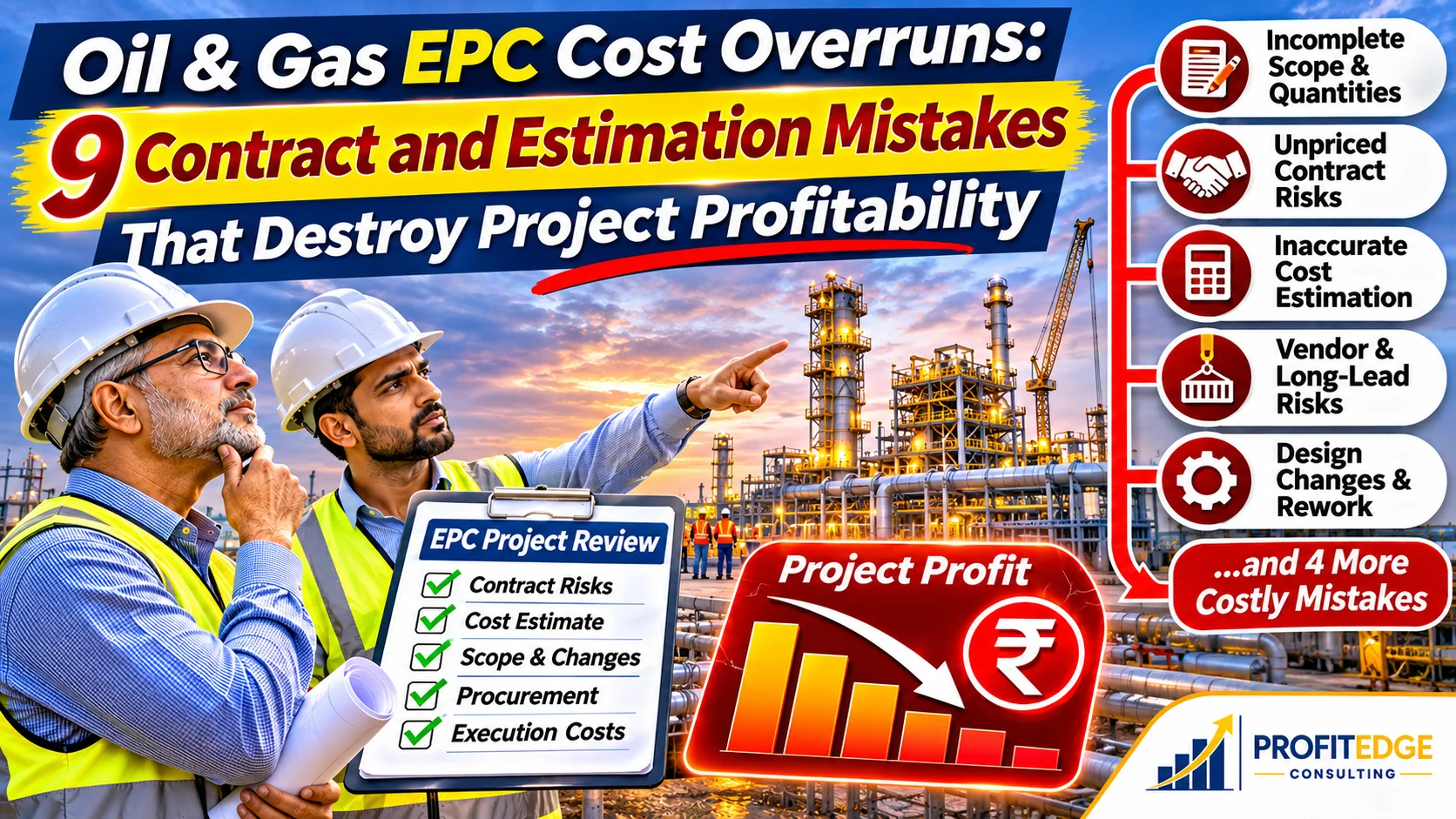
Your company has secured a major Oil & Gas EPC contract. The order value looks attractive. The project team is mobilised. Engineering and procurement have started. But have you calculated how much profit your company will actually retain when the project is completed?
In Oil & Gas EPC projects, winning a large contract does not automatically mean winning a profitable contract.
A single estimation error, an inadequately priced contractual obligation, an overlooked interface, a delayed vendor package or an unapproved scope change can consume a significant part of the contractor's expected margin.
The problem is that many of these risks are created before construction even begins.
By the time the project team recognises them, the contractor may already be committed to fixed prices, delivery obligations, performance guarantees and contractual penalties.
This is why Oil and Gas EPC Cost Overruns are not simply a project execution problem. They are frequently the result of decisions made during bidding, contract negotiation, engineering planning and cost estimation.
1. Why Oil & Gas EPC Projects Are Particularly Exposed to Cost Overruns
Oil and gas facilities involve complex engineering, specialised equipment, process systems, piping networks, electrical and instrumentation packages, safety requirements, commissioning and multiple contractor interfaces.
Depending on the project, the scope may include:
- Oil and gas processing facilities.
- Refineries and petrochemical plants.
- Gas compression and treatment facilities.
- Storage tanks and terminal infrastructure.
- Cross-country and plant pipelines.
- Offshore and onshore facilities.
- Mechanical, electrical and instrumentation systems.
- Utilities, fire protection and safety systems.
Each discipline has different cost drivers, procurement lead times, technical requirements and execution risks.
For example, a change in process design may affect equipment sizing, piping quantities, structural requirements, electrical loads, instrumentation, procurement and construction sequencing.
A seemingly small engineering decision can therefore create a chain of cost consequences across the project.
Research published in the journal Sustainability on turnkey industrial projects identified construction, preliminary project phases and project management as major contributors to delays and cost overruns in refining, gas and electricity projects. The study highlights the importance of addressing risks throughout the project lifecycle.
Reference: Analysis of Causes of Delays and Cost Overruns in Turnkey Industrial Projects.
2. Nine Contract and Estimation Mistakes That Destroy Oil & Gas EPC Profitability
1. Underestimating the Actual Project Scope During Bidding
One of the most expensive mistakes in Oil & Gas EPC bidding is preparing a price before the scope is sufficiently defined.
At the bidding stage, the contractor may receive preliminary engineering documents, process descriptions, equipment specifications, plot plans, P&IDs and other technical information.
However, important details may still be incomplete.
Examples include:
- Incomplete process design and engineering deliverables.
- Insufficiently defined battery limits and scope boundaries.
- Unclear tie-in points and existing facility interfaces.
- Incomplete equipment specifications.
- Unidentified utility and offsite requirements.
- Incomplete quantities for piping, cables and structural steel.
- Unclear testing, commissioning and performance requirements.
If the bid team assumes that missing details will have little cost impact, the company may submit a price that does not reflect the actual execution obligation.
What management should do: Establish a formal scope-gap register before finalising the bid. Every assumption, exclusion, interface and unresolved technical requirement should have an owner and a commercial treatment.
2. Accepting Fixed-Price Contractual Risks Without Proper Risk Pricing
A fixed-price or lump-sum EPC contract can offer the client greater price certainty. But it can expose the contractor to substantial cost risk.
Before signing, management must understand exactly which risks are being transferred to the EPC contractor.
These may include:
- Design development and coordination risks.
- Procurement price and availability risks.
- Construction productivity risks.
- Ground or site-condition risks, depending on the contract.
- Interface and subcontractor coordination risks.
- Testing, commissioning and performance obligations.
- Schedule and delay-related liabilities.
A contract can look commercially attractive because the contract value is large. But if the contractor accepts risks it cannot reasonably control, the expected margin may be inadequate.
The FIDIC Silver Book is an example of an EPC/Turnkey contract form that places a wider range of responsibilities on the contractor than more traditional arrangements. FIDIC also recognises that contractors need adequate information and time to assess risks before accepting such obligations.
Reference: FIDIC – EPC/Turnkey Contract, Silver Book.
What management should do: Conduct a contract risk review before signing. Every material risk should be assessed for probability, financial impact, control ownership, insurance, contingency and contractual relief.
3. Inaccurate EPC Project Cost Estimation
An EPC estimate is only as reliable as its scope definition, technical inputs, quantities, rates, productivity assumptions and risk allowances.
In many organisations, bid estimates are prepared under tight deadlines. Different disciplines may use different assumptions, and the final estimate may not receive sufficient independent challenge.
Common estimation gaps include:
- Incomplete piping and instrumentation quantities.
- Incorrect equipment and package cost assumptions.
- Underestimated electrical and instrumentation scope.
- Insufficient construction labour hours.
- Unrealistic productivity assumptions.
- Missing temporary facilities and construction support costs.
- Inadequate commissioning and testing allowances.
- Insufficient indirect costs and contingency.
The result is an estimate that appears competitive but may not be executable at the assumed cost.
The AACE International cost-estimate classification guidance explains the relationship between estimate classification, scope definition maturity and estimate characteristics. Its petroleum exploration and production guidance also provides an industry-specific framework for evaluating estimate inputs and basis-of-estimate documentation.
References:
- AACE Recommended Practice 87R-14 – Petroleum Exploration and Production Cost Estimate Classification
- AACE – Guide to Cost Estimate Classification Systems
What management should do: Introduce independent estimate reviews, a documented basis of estimate, quantity validation, discipline-wise cost checks and risk-based contingency assessment.
4. Ignoring Long-Lead Equipment and Vendor Price Risks
Oil & Gas EPC projects depend on specialised equipment and engineered packages.
Depending on the project, these may include:
- Compressors and turbines.
- Pressure vessels and heat exchangers.
- Reactors and columns.
- Pumps and specialised valves.
- Electrical switchgear and transformers.
- Control systems and instrumentation packages.
- Packaged skids and specialised process equipment.
During bidding, the contractor may rely on budgetary quotations or preliminary vendor offers. These prices may not remain valid until purchase order placement.
Additional costs can arise from:
- Vendor price validity expiry.
- Changes in technical specifications.
- Currency exchange movements.
- Freight, insurance and customs-related costs.
- Inspection and testing requirements.
- Expediting and manufacturing delays.
- Vendor deviations and revised documentation.
Long-lead equipment can also affect the project schedule. If a critical package arrives late, the contractor may face extended site overheads, resequencing, additional resources or commissioning delays.
What management should do: Establish a procurement risk register that tracks vendor quotations, validity, technical deviations, delivery schedules, escalation exposure, logistics and alternative suppliers.
5. Underestimating Engineering Changes and Design Rework
Engineering changes are a major source of cost exposure in complex process projects.
A modification in process requirements or equipment specifications can affect several interconnected engineering disciplines.
For example, a change in equipment capacity may lead to revisions in:
- Process calculations and equipment sizing.
- Piping layouts and material take-offs.
- Structural and foundation design.
- Electrical loads and cable schedules.
- Instrumentation and control logic.
- Procurement specifications and vendor drawings.
- Construction sequencing and installation work.
When revisions occur after procurement or construction has started, the cost impact may be significantly higher than if the change had been identified during early engineering.
What management should do: Implement formal change control. Every significant design change should be assessed for engineering hours, procurement impact, construction rework, schedule impact and contractual entitlement.
6. Poor Contract Management and Failure to Protect Commercial Entitlements
Even when additional work or changed conditions arise, the contractor may not automatically receive additional payment.
Contractual entitlement depends on the specific agreement, notice requirements, approval procedures, records and applicable law.
Common contract-management mistakes include:
- Failure to identify changes in the employer's requirements.
- Late contractual notices.
- Inadequate records of instructions and site events.
- Executing extra work without documenting its basis.
- Failure to track variations and claims.
- Incomplete supporting measurements and cost records.
- Weak coordination between project, commercial and legal teams.
For example, a client may request a modification that requires additional engineering, materials and installation work. If the contractor fails to follow the contract's required notice and change procedures, it may face difficulty establishing its entitlement.
What management should do: Create a contract obligation matrix and a live change-and-claims register. Review notices, submissions, approvals, disputed items and pending commercial decisions every month.
Related reading: Project Recovery Services.
7. Underestimating Construction Productivity and Site Indirect Costs
A project estimate may assume a particular labour productivity rate, installation sequence and construction duration.
Actual execution can be very different.
Productivity may be affected by:
- Restricted work fronts.
- Congested construction areas.
- Permit-to-work restrictions.
- Simultaneous operations and safety controls.
- Material availability and handling.
- Rework and inspection delays.
- Subcontractor performance.
- Weather and site access conditions.
Lower productivity increases labour hours and may require additional equipment, supervision and subcontractor resources.
Site indirect costs can also rise when project execution takes longer than the estimate assumed.
These may include site management, temporary facilities, security, utilities, transport, accommodation, construction support and other project overheads.
What management should do: Compare planned and actual productivity by discipline, work package and subcontractor. Forecast remaining labour hours and site indirect costs based on actual performance rather than the original bid assumptions alone.
8. Inadequate Commissioning, Testing and Performance Guarantee Allowances
In Oil & Gas EPC projects, mechanical completion does not necessarily mean the project is commercially complete.
Testing, pre-commissioning, commissioning, start-up and performance demonstration may require substantial time and resources.
Underestimation can occur when the bid team does not adequately consider:
- Pre-commissioning and flushing requirements.
- Pressure testing and reinstatement.
- Electrical and instrumentation loop checks.
- Control system integration.
- Performance testing and demonstration runs.
- Vendor commissioning support.
- Consumables, temporary facilities and specialist resources.
- Client inspection and acceptance requirements.
Performance guarantees and liquidated damages can also create financial exposure if the contractor does not meet the applicable contractual requirements.
What management should do: Prepare a commissioning cost and resource plan during bidding and update it during execution. Link completion milestones, performance tests, acceptance criteria and contractual obligations to the project cost forecast.
9. Failing to Integrate Cost, Schedule, Procurement and Cash Flow Control
Perhaps the most damaging management mistake is treating cost, schedule, procurement, engineering and cash flow as separate reporting activities.
These areas are connected.
A delayed vendor package may affect construction sequencing. Construction resequencing may increase labour and equipment costs. Delayed completion may extend site overheads. Late certification may delay cash collection. The combined impact may reduce project profitability.
When different departments report different versions of project performance, management may not see the financial consequences until too late.
What management should do: Introduce an integrated project-control system that connects:
- Engineering progress and design maturity.
- Procurement commitments and delivery schedules.
- Construction progress and productivity.
- Actual expenditure and commitments.
- Variations, claims and contractual notices.
- Cash flow, billing and collections.
- Forecast final cost and project contribution.
This is essential for preventing Oil and Gas EPC Cost Overruns from becoming visible only after the margin has been lost.
3. The ₹500 Crore Oil & Gas EPC Contract: How ₹40 Crore Expected Profit Can Disappear
Consider an illustrative Oil & Gas EPC contract with a value of ₹500 crore.
During bidding, the contractor estimates the project cost at ₹460 crore and expects a contribution of ₹40 crore.
| Particulars | Original estimate | Revised forecast |
|---|---|---|
| Contract value | ₹500 crore | ₹500 crore |
| Estimated project cost | ₹460 crore | ₹485 crore |
| Expected contribution | ₹40 crore | ₹15 crore |
| Contribution margin | 8.0% | 3.0% |
Assume the following illustrative additional costs emerge during execution:
| Cost overrun source | Additional cost |
|---|---|
| Scope and quantity estimation gaps | ₹4 crore |
| Vendor price and procurement exposure | ₹5 crore |
| Engineering changes and rework | ₹3 crore |
| Construction productivity shortfall | ₹4 crore |
| Extended site indirect costs | ₹3 crore |
| Commissioning and testing exposure | ₹2 crore |
| Financing and other project costs | ₹4 crore |
| Total additional cost | ₹25 crore |
₹25 Crore Contribution Reduction
Original expected contribution: ₹40 crore
Revised forecast contribution: ₹15 crore
Reduction in expected contribution: 62.5%
The contract value has not changed, but the expected contribution has fallen by more than 60%.
This is the commercial impact of Oil and Gas EPC Cost Overruns when bid assumptions, contract exposure and execution costs are not managed together.
The example is illustrative. Actual project outcomes depend on contract structure, scope, execution conditions, approved variations, claims, risk allocation and cost accounting treatment. It is not an actual ProfitEdge client case or an industry benchmark.
4. The EPC Contract Management Checklist Before Signing a Major Oil & Gas Contract
Before accepting a major EPC contract, the CEO, CFO, project director, commercial head and legal team should jointly review the following areas.
| Contract area | What must be checked |
|---|---|
| Scope definition | Scope boundaries, exclusions, battery limits, interfaces and employer requirements. |
| Price and payment | Payment milestones, price adjustment, taxes, currency exposure and payment conditions. |
| Variations | Change procedures, notices, valuation rules and approval authority. |
| Schedule | Milestones, completion dates, extensions of time and delay consequences. |
| Liquidated damages | Delay and performance LD provisions, caps and applicable conditions. |
| Performance guarantees | Guaranteed parameters, test procedures and acceptance criteria. |
| Site conditions | Access, existing facilities, underground services and available site information. |
| Subcontracting | Flow-down obligations, back-to-back terms and subcontractor risk. |
| Insurance and indemnities | Coverage, exclusions, liability allocation and contractual requirements. |
| Claims and disputes | Notice periods, supporting records, escalation and dispute resolution. |
AACE International's recommended practice on contract risk allocation in EPC projects is a useful reference for understanding how risks should be identified and allocated among contracting parties.
Reference: AACE Recommended Practice 67R-11 – Contract Risk Allocation in EPC.
5. How to Improve EPC Project Cost Estimation Before Submitting the Bid
Strong EPC Project Cost Estimation starts with a disciplined estimating process, not simply collecting vendor quotations and adding a margin.
A robust estimate should cover the following areas:
A. Engineering and technical scope
- Process design and engineering deliverables.
- Equipment and package specifications.
- Piping and instrumentation scope.
- Electrical and instrumentation quantities.
- Civil, structural and architectural works.
- Utilities and offsite requirements.
B. Procurement and supply chain
- Budgetary and firm vendor quotations.
- Price validity and escalation exposure.
- Freight, insurance and logistics.
- Import duties and applicable taxes.
- Inspection, expediting and vendor documentation.
- Long-lead equipment delivery assumptions.
C. Construction and installation
- Discipline-wise labour hours.
- Installation productivity assumptions.
- Equipment and temporary facilities.
- Subcontractor rates and scope.
- Site access and construction sequencing.
- Testing, pre-commissioning and commissioning.
D. Indirect costs and risk provisions
- Project management and site overheads.
- Engineering management and coordination.
- Insurance, bonds and bank guarantees.
- Financing and cash-flow requirements.
- Escalation and foreign exchange exposure.
- Risk-based contingency and management reserve.
The estimate should also have a clear basis-of-estimate document. This should record assumptions, exclusions, pricing dates, source data, quantities, productivity rates, estimate maturity and identified risks.
AACE guidance emphasises that estimate classification and accuracy depend on project definition and other project-specific variables. Contingency should be informed by risk analysis rather than selected as an arbitrary percentage.
6. Oil and Gas Project Cost Control: What Should Be Monitored Every Month?
Once the contract is awarded, the organisation needs a reliable system to compare the original estimate with actual performance and the forecast final outcome.
Management should not rely only on actual expenditure. Purchase commitments, remaining work, pending changes, forecast productivity and schedule exposure must also be considered.
Key indicators include:
| KPI | What it measures | Management question |
|---|---|---|
| Estimate at Completion (EAC) | Forecast total project cost | What will the final project cost be? |
| Cost to Complete (CTC) | Forecast remaining expenditure | How much will it cost to finish? |
| Engineering productivity | Actual versus planned engineering hours and deliverables | Are engineering resources being used efficiently? |
| Procurement variance | Budget versus purchase-order commitments and actual costs | Are vendor packages within budget? |
| Construction productivity | Actual output versus planned output and labour hours | Are we installing at the expected rate? |
| Change-order exposure | Submitted, approved, pending and disputed changes | Are additional costs commercially protected? |
| Schedule performance | Actual progress versus baseline | Which milestones are at risk? |
| Site indirect cost | Actual and forecast project overhead | Is the project duration increasing overhead? |
| Unbilled revenue | Completed work awaiting billing | Why is completed work not converted into invoices? |
| Forecast contribution | Expected final project contribution | Are we protecting the planned margin? |
These indicators should be reviewed together. A project may be on schedule but over budget. It may be under budget because procurement has not yet taken place. It may show a positive forecast while unresolved claims or commissioning costs remain unaccounted for.
Reliable Oil and Gas EPC Cost Overruns prevention requires management to look forward, not merely report what has already happened.
7. EPC Project Profitability: Why CEOs Need a Different Project Review
Traditional project reviews often concentrate on schedule, engineering deliverables, procurement status and construction progress.
These are important, but the CEO must also understand the commercial outcome.
A project profitability review should answer five questions:
- What was the original expected contribution at contract award?
- What is the latest forecast contribution?
- Which cost categories are responsible for the difference?
- Which risks can still be prevented, mitigated or contractually addressed?
- Who owns each corrective action, and when will the financial benefit be visible?
The review should connect project performance with the company's overall EBITDA, cash flow, working capital and risk exposure.
Related reading: EBITDA Improvement Consulting.
8. A 30-Day Action Plan to Identify and Control EPC Cost Overruns
| Period | Management action | Expected output |
|---|---|---|
| Days 1–5 | Review contract, scope, estimate and key commercial assumptions. | Contract and estimate risk register. |
| Days 6–10 | Reconcile original budget, actual expenditure and committed costs. | Reliable cost baseline. |
| Days 11–15 | Review engineering changes, vendor exposure and construction productivity. | Cost leakage analysis. |
| Days 16–20 | Assess variations, claims, unbilled work and contractual notices. | Commercial recovery and protection plan. |
| Days 21–25 | Prepare cost-to-complete and estimate-at-completion forecasts. | Revised project financial forecast. |
| Days 26–30 | Agree corrective actions with owners and review governance. | CEO-level project profitability action plan. |
The objective is not merely to identify overruns. It is to identify their causes, quantify their financial impact and take action before further contribution is lost.
9. Warning Signs Your Oil & Gas EPC Project May Be Losing Money
CEOs should investigate immediately when they see these warning signs:
- The project budget has not been updated after major design changes.
- Vendor quotations have expired or purchase orders exceed the estimate.
- Engineering revisions are increasing without a clear cost-impact report.
- Construction labour hours are consistently above the planned norms.
- Subcontractor bills are higher than the earned progress.
- Additional work is being executed without timely commercial documentation.
- Commissioning costs are missing from the forecast.
- Site overheads are increasing because of extended execution duration.
- The project team cannot explain the latest forecast contribution.
10. Conclusion: Winning an Oil & Gas EPC Contract Is Not the Same as Making Money
Oil & Gas EPC projects require more than engineering capability and execution capacity. They require commercial discipline, accurate cost estimation, strong contract management and integrated project controls.
The nine mistakes discussed in this article often originate at the bidding and contract stages, but their financial consequences emerge throughout execution.
To reduce Oil and Gas EPC Cost Overruns, management should focus on:
- Validating scope before submitting the bid.
- Pricing contractual risks realistically.
- Strengthening EPC Project Cost Estimation.
- Controlling vendor commitments and procurement exposure.
- Managing engineering changes and rework.
- Protecting contractual entitlements through effective EPC Contract Management.
- Measuring construction productivity and indirect costs.
- Planning commissioning and performance obligations.
- Integrating cost, schedule, procurement and cash-flow reporting.
Ultimately, EPC Project Profitability is determined not by the size of the order book but by how effectively the company converts its contracts into profitable, cash-generating projects.
One Question Every Oil & Gas EPC CEO Should Ask
Your company has won a ₹500 crore EPC contract. The original estimate shows ₹40 crore contribution.
How much of that ₹40 crore is genuinely protected by your estimate, contract terms, procurement commitments and project-control systems?
Are Cost Overruns Eroding Your EPC Project Margins?
ProfitEdge Consulting helps EPC and infrastructure businesses identify profitability leakages, strengthen project cost controls, improve execution performance and protect EBITDA.
Evaluate the gaps in your project controls, commercial processes and business performance.
Request a Free Business Performance Assessment Contact ProfitEdge ConsultingFrequently Asked Questions
1. What are the main causes of Oil and Gas EPC Cost Overruns?
Common causes include incomplete scope definition, inaccurate cost estimates, poorly allocated contractual risks, vendor price changes, engineering revisions, construction productivity shortfalls, commissioning exposure and weak project controls.
2. How can EPC contractors prevent cost overruns in oil and gas projects?
Contractors should validate the scope before bidding, prepare a documented basis of estimate, price risks appropriately, control procurement commitments, manage engineering changes and regularly forecast estimate at completion.
3. What is EPC Project Cost Estimation?
EPC Project Cost Estimation is the process of forecasting the total cost of engineering, procurement, construction, testing and commissioning, together with project indirect costs, risk provisions and other contractual obligations.
4. Why is EPC Contract Management important for profitability?
It helps contractors understand scope obligations, allocate risks, manage variations, comply with notice requirements, document additional work and protect contractual entitlements. Weak contract management can turn legitimate cost changes into unrecovered expenses.
5. What is the difference between cost overrun and schedule delay?
A cost overrun occurs when the forecast or actual project cost exceeds the approved budget. A schedule delay occurs when project activities or contractual milestones take longer than planned. The two can be connected, but a project can experience one without necessarily experiencing the other.
6. What is Estimate at Completion (EAC) in an EPC project?
Estimate at Completion is the forecast total cost expected when the project is finished. It should include actual costs, remaining work, commitments and expected future costs based on current project conditions.
7. How do engineering changes affect Oil & Gas EPC profitability?
Engineering changes can affect equipment specifications, procurement, piping quantities, structures, electrical and instrumentation systems, construction sequencing and commissioning. Changes made after procurement or construction can generate additional costs and rework.
8. What should an EPC CEO review to control project costs?
The CEO should review forecast final cost, cost to complete, procurement commitments, engineering changes, construction productivity, subcontractor costs, variation status, schedule exposure, commissioning requirements, cash flow and forecast contribution.
9. How can EPC companies improve project profitability?
They can improve profitability by strengthening bid discipline, improving estimation accuracy, controlling contractual risks, reducing rework, improving procurement and construction productivity, managing variations and integrating financial and operational project reporting.
10. Can a business performance consultant help an Oil & Gas EPC company?
Yes. A business performance consultant can assess project cost control, estimating practices, procurement, contract management, execution productivity, working capital and management reporting. The focus is on identifying measurable performance gaps and implementing corrective actions.
About the Author

Founder & Principal Consultant, ProfitEdge Consulting
35+ years of industry and consulting experience in business performance improvement, project execution, cost optimisation and profitability enhancement.