
Your railway EPC project is progressing. Track installation is moving forward, structures are taking shape, electrical works are underway and project milestones are being achieved. But is the project actually making money?
A railway infrastructure contract can look attractive when the order is awarded. The contract value is substantial, the project timeline is defined and the expected margin appears reasonable.
However, the final financial result may be very different.
Unanticipated site conditions, inaccurate quantities, utility shifting, design changes, delayed approvals, subcontractor inefficiencies and poor cost forecasting can gradually erode the contractor's expected contribution.
The most dangerous situation is when the project appears operationally healthy but its financial performance is deteriorating.
This is why Railway EPC Profitability cannot be measured only through physical progress or milestone achievement. It must be measured through actual costs, committed expenditure, remaining work, contractual recovery and forecast contribution.
1. Why Railway EPC Projects Face Hidden Profitability Risks
Railway EPC projects can involve several interconnected work packages. Depending on the contract, the scope may include:
- Railway track construction, renewal and rehabilitation.
- Formation, earthwork, embankments and drainage.
- Bridges, viaducts, culverts and other civil structures.
- Railway stations, platforms and associated buildings.
- Track electrification and overhead equipment.
- Signalling and telecommunications systems.
- Traction substations and electrical infrastructure.
- Yards, loops, sidings and associated facilities.
- Testing, inspection, safety approvals and commissioning.
These activities depend on multiple agencies, technical approvals, site access, work permits, railway blocks, material availability and coordination between civil, track, electrical and signalling teams.
A delay or change in one work package can affect several others.
For example, delayed completion of a bridge or formation section may prevent track installation. A delay in track readiness may affect electrification and signalling activities. Changes in site access or approved drawings may require construction resequencing and additional resources.
These dependencies create financial exposure even when individual teams report satisfactory progress.
Railway EPC Profitability therefore requires integrated management of engineering, procurement, construction, contracts, schedule and finance.
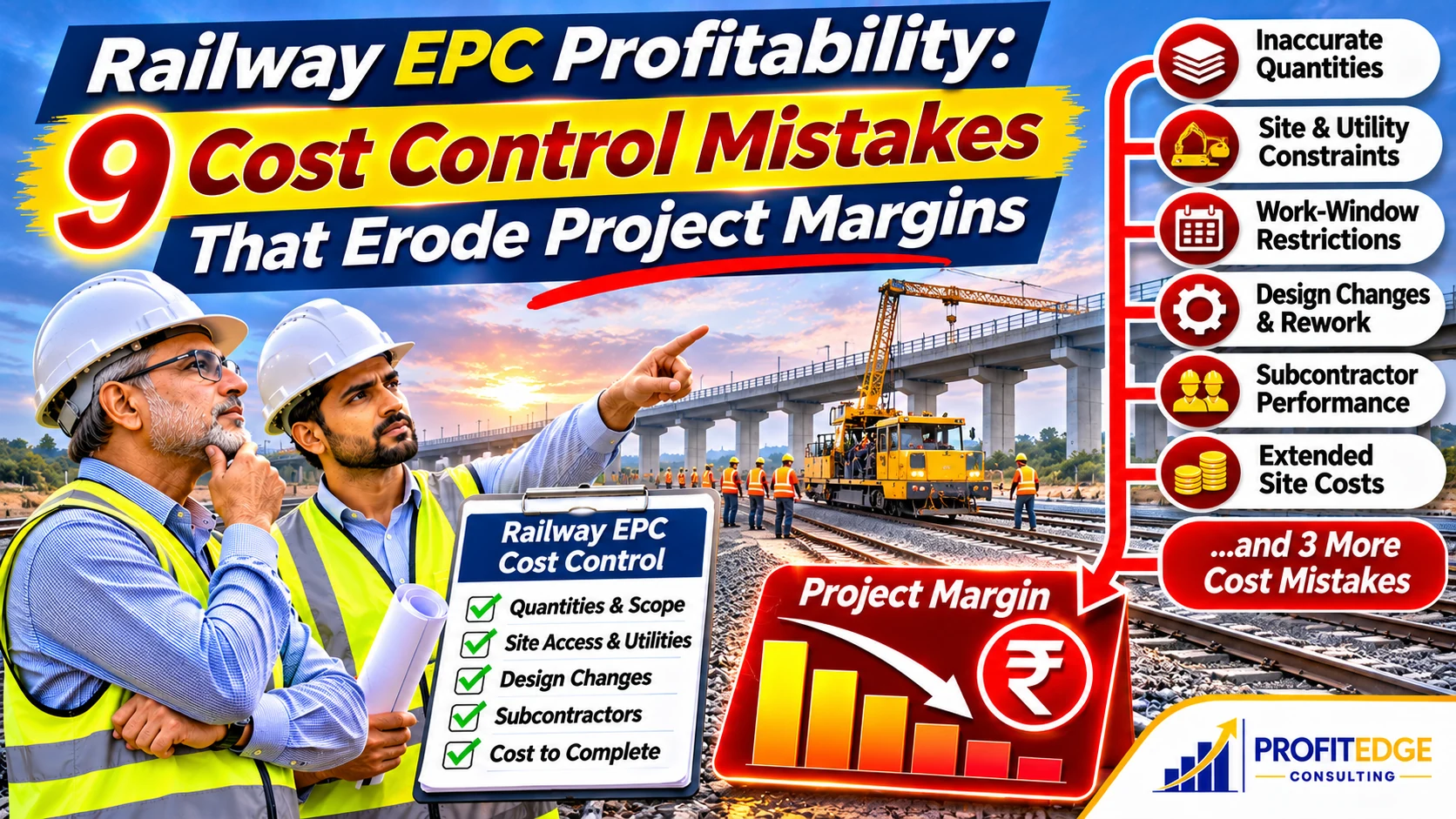
2. Nine Cost Control Mistakes That Erode Railway EPC Project Margins
1. Inaccurate Quantity Estimation During Bidding
One of the most common sources of railway EPC cost exposure is an inaccurate assessment of the quantities required to complete the contracted scope.
At the bidding stage, estimates may be prepared using preliminary drawings, tender schedules, site information and available technical documents.
If quantities are not independently validated, the contractor may underestimate the actual requirement for:
- Earthwork, excavation and embankment construction.
- Ballast, sleepers, rails and track fittings.
- Reinforcement steel and structural concrete.
- Drainage, retaining structures and protection works.
- Overhead electrification materials and foundations.
- Cables, signalling equipment and installation accessories.
- Temporary works, access roads and construction facilities.
Even a small percentage difference in a large project quantity can create a substantial financial impact.
For example, an underestimation of excavation or concrete quantities may increase material, equipment, labour, transport and subcontracting costs simultaneously.
What management should do: Independently validate major quantities, compare tender schedules with drawings and site conditions, document assumptions and identify high-value quantity risks before finalising the bid.
2. Underestimating Land, Site Access and Utility Shifting Constraints
Railway construction often takes place in or around operational railway corridors, existing infrastructure, urban areas and locations with multiple utility interfaces.
Site access and availability may not be as straightforward as assumed during bidding.
Potential cost drivers include:
- Delayed availability of required work fronts.
- Existing underground and overhead utilities.
- Shifting or protection of electrical and communication lines.
- Restricted access for construction equipment.
- Coordination with local authorities and utility owners.
- Work restrictions near operational railway assets.
- Additional temporary access and protection arrangements.
When the site is not available as planned, the contractor may have to move labour, machinery and materials to alternative work fronts. This can increase transport costs, idle time, supervision expenses and execution inefficiency.
What management should do: Prepare a site-readiness and interface register before mobilisation. Track access availability, utility dependencies, approvals, handover dates and responsibility for each outstanding constraint.
3. Ignoring Railway Block, Permit and Work-Window Constraints
Work near operational railway infrastructure may require approved blocks, traffic coordination, permits, safety arrangements and specific execution windows.
These restrictions can affect productivity and the sequence in which activities are performed.
For example, a contractor may plan to complete a particular activity within a defined shift or block. If the available work window is shorter than expected, or the planned activity cannot be completed, resources may need to be remobilised or work rescheduled.
Potential cost consequences include:
- Lower equipment and labour utilisation.
- Additional shifts and overtime.
- Repeated mobilisation and demobilisation.
- Increased supervision and safety-related costs.
- Construction resequencing and additional temporary works.
- Reduced productivity across dependent work packages.
What management should do: Link the construction programme to approved work windows and operational constraints. Measure actual output per block or work window and compare it with the estimate assumptions.
4. Poor Control of Design Changes and Engineering Rework
Railway projects involve multiple engineering disciplines. A change in one area may affect the design, quantities and execution of several other work packages.
Examples include:
- Changes in alignment, levels or formation requirements.
- Revisions to bridge and structural designs.
- Changes in drainage and protection works.
- Revised station or platform layouts.
- Changes in overhead electrification arrangements.
- Revisions to signalling, cable routes and equipment locations.
- Changes in interfaces between civil, electrical and signalling systems.
When design changes occur after procurement or construction has started, the contractor may face rework, material wastage, additional engineering hours and disruption to the construction sequence.
What management should do: Introduce formal engineering change control. Every significant revision should be assessed for quantity changes, procurement impact, construction rework, schedule implications and contractual entitlement.
5. Inadequate Procurement Planning and Material Cost Control
Railway EPC projects depend on materials and equipment with specific technical requirements, inspection procedures and delivery schedules.
Depending on the contract, major procurement items may include:
- Rails, sleepers, fastenings and track components.
- Ballast and construction materials.
- Structural steel and reinforcement.
- Overhead electrification equipment.
- Transformers, switchgear and electrical systems.
- Signalling equipment and communication systems.
- Cables, control panels and associated accessories.
Procurement costs can exceed the original estimate because of price changes, delayed ordering, freight, specification revisions, vendor availability and inadequate material planning.
Late procurement may also force the project team to resequence work or keep construction resources waiting for materials.
What management should do: Establish a procurement control system that compares budgeted rates, approved purchase orders, actual landed costs, delivery commitments and remaining material requirements.
6. Weak Subcontractor Selection and Productivity Monitoring
Many railway EPC contractors depend on subcontractors for civil works, track installation, electrical works, signalling, equipment installation and other specialised activities.
Subcontracting can improve execution capacity, but poorly managed subcontract packages can create serious cost exposure.
Common mistakes include:
- Selecting subcontractors primarily on the lowest quoted price.
- Unclear scope boundaries and interface responsibilities.
- Inadequate assessment of equipment and manpower capacity.
- Weak productivity measurement.
- Delayed measurement and certification of work.
- Uncontrolled extra work and variation requests.
- Failure to track rework and quality-related costs.
A subcontractor may appear inexpensive at the award stage but become expensive if productivity is poor, quality failures create rework or additional resources are needed to complete the work.
What management should do: Review subcontractors using cost, productivity, quality, safety, schedule and claims performance. Compare actual cost per unit of completed work against the approved estimate.
7. Poor Control of Contract Variations, Claims and Additional Work
Railway EPC projects can experience changes in quantities, drawings, site conditions, access arrangements and execution requirements.
However, the contractor's ability to recover the additional cost depends on the contract and compliance with its procedures.
Common commercial management failures include:
- Failure to identify changes in the employer's requirements.
- Late or incomplete contractual notices.
- Executing additional work without adequate documentation.
- Insufficient records of site instructions and events.
- Failure to maintain measurement and cost records.
- Delayed submission of variation proposals.
- Inadequate follow-up of pending approvals and claims.
For example, a site instruction may require additional work that was not included in the original scope. If the contractor does not document the instruction, its impact and the applicable contractual procedure, commercial recovery may become difficult.
What management should do: Maintain a live variation and claims register. Review submitted, approved, pending and disputed amounts, contractual notices, supporting evidence and responsible owners every month.
Related reading: Project Recovery Services.
8. Ignoring Cost of Delays, Idle Resources and Extended Site Overheads
A railway EPC project may achieve some physical milestones while other work fronts remain blocked.
This can create a misleading picture of progress.
When activities are delayed or resequenced, the contractor may incur additional costs such as:
- Idle or underutilised machinery.
- Extended site management and supervision.
- Additional labour and equipment mobilisation.
- Higher accommodation, transport and temporary facility costs.
- Additional security and site maintenance.
- Subcontractor prolongation claims.
- Financing costs arising from delayed billing and collection.
Site overheads are particularly important because they may continue for the duration of the project even when physical output is lower than planned.
What management should do: Forecast site indirect costs using the latest expected completion date, actual monthly expenditure and the remaining execution plan. Separate productive costs from idle and prolongation-related costs.
9. Failing to Integrate Project Cost, Schedule, Billing and Cash Flow
The most damaging management mistake is allowing project cost, schedule, procurement, billing and finance teams to work with disconnected information.
For example:
- Construction reports physical progress but does not quantify cost-to-complete.
- Procurement reports purchase orders but not the full committed cost exposure.
- Finance reports expenditure but does not include all future obligations.
- Commercial teams track claims but do not connect them to the project forecast.
- Billing teams report invoices but do not identify completed work awaiting certification.
As a result, management may receive several reports that each look reasonable but do not reveal the actual financial condition of the project.
What management should do: Create one integrated project-performance dashboard connecting engineering, procurement, construction, commitments, actual expenditure, variations, billing, collections and forecast final contribution.
This is essential to improving Railway EPC Profitability and preventing cost leakage from remaining hidden until project closure.
3. The ₹300 Crore Railway EPC Project: How ₹24 Crore Expected Profit Can Disappear
Consider an illustrative railway infrastructure EPC contract worth ₹300 crore.
At the time of bidding, the contractor estimates the total project cost at ₹276 crore and expects a contribution of ₹24 crore.
| Particulars | Original estimate | Revised forecast |
|---|---|---|
| Contract value | ₹300 crore | ₹300 crore |
| Estimated project cost | ₹276 crore | ₹291 crore |
| Expected contribution | ₹24 crore | ₹9 crore |
| Contribution margin | 8.0% | 3.0% |
Assume the following illustrative additional costs arise during execution:
| Cost overrun source | Additional cost |
|---|---|
| Quantity estimation gaps | ₹2.5 crore |
| Site access and utility-related constraints | ₹2.0 crore |
| Work-window and productivity losses | ₹1.5 crore |
| Engineering changes and rework | ₹2.0 crore |
| Procurement cost escalation | ₹1.5 crore |
| Subcontractor productivity shortfall | ₹2.0 crore |
| Extended site indirect costs | ₹2.0 crore |
| Financing and other project costs | ₹1.5 crore |
| Total additional cost | ₹15 crore |
₹15 Crore Reduction in Expected Contribution
Original expected contribution: ₹24 crore
Revised forecast contribution: ₹9 crore
Reduction in expected contribution: 62.5%
The contract value remains ₹300 crore, but the expected contribution has fallen by more than 60%.
This illustrates how Railway EPC Profitability can deteriorate through several small and large cost leakages occurring across the project lifecycle.
The example is illustrative only. It is not an actual ProfitEdge client case or an industry benchmark. Actual project outcomes depend on scope, contract terms, site conditions, approved variations, claims, execution performance and cost-accounting treatment.
4. Railway EPC Project Cost Control: What Should Management Monitor?
To protect project margins, management must monitor more than actual expenditure. It must also understand committed costs, remaining work, pending variations and the expected final project cost.
The following KPIs can help management identify deterioration early.
| KPI | What it measures | CEO's management question |
|---|---|---|
| Estimate at Completion (EAC) | Forecast total project cost | What will the final cost be? |
| Cost to Complete (CTC) | Forecast cost of remaining work | How much more will we spend? |
| Quantity variance | Actual and forecast quantities against estimate | Are we consuming more than planned? |
| Material cost variance | Budgeted versus actual and committed material costs | Are procurement costs under control? |
| Labour productivity | Output achieved against labour hours | Are resources delivering planned output? |
| Equipment utilisation | Productive versus idle equipment hours | Are expensive assets being used effectively? |
| Subcontractor performance | Cost, output, quality and schedule performance | Are subcontract packages profitable? |
| Variation and claims status | Submitted, approved, pending and disputed amounts | Are additional costs being commercially protected? |
| Site indirect costs | Actual and forecast project overheads | Is the project duration increasing overhead? |
| Unbilled revenue | Completed work awaiting billing or certification | Are completed activities being converted into cash? |
| Forecast contribution | Expected final project contribution | Are we protecting the original margin? |
A project can be on schedule and still be over budget. It can also be under budget temporarily because procurement or construction expenditure has not yet occurred.
For this reason, the project review should focus on the latest forecast, not simply the difference between the original budget and expenditure to date.
5. Railway EPC Profitability: What Should the CEO Review Every Month?
Traditional project reviews often focus on physical progress, milestone achievement, manpower deployment and pending activities.
These are important, but they do not provide a complete picture of financial performance.
A CEO-level Railway EPC Profitability review should answer the following questions:
- What was the expected contribution when the contract was awarded?
- What is the latest forecast contribution?
- Which work packages are responsible for cost overruns?
- Are committed procurement costs within the approved estimate?
- Which site constraints are reducing labour and equipment productivity?
- Are variations and additional work being properly documented and submitted?
- What is the latest cost to complete?
- How much completed work is awaiting billing or certification?
- What corrective actions can still prevent further margin erosion?
Every major variance should have a quantified financial impact, a responsible owner and a target date for corrective action.
Related reading: EBITDA Improvement Consulting.
6. A 30-Day Action Plan to Improve Railway EPC Profitability
| Period | Management action | Expected output |
|---|---|---|
| Days 1–5 | Review contract scope, original estimate, quantities and key assumptions. | Scope and estimate risk register. |
| Days 6–10 | Reconcile actual expenditure, commitments and remaining work. | Reliable cost baseline. |
| Days 11–15 | Review site constraints, work windows, productivity and subcontractor performance. | Execution cost leakage analysis. |
| Days 16–20 | Assess engineering changes, variations, claims and unbilled work. | Commercial protection and recovery plan. |
| Days 21–25 | Prepare updated cost-to-complete and estimate-at-completion forecasts. | Revised project financial forecast. |
| Days 26–30 | Agree corrective actions, ownership and management review frequency. | CEO-level profitability action plan. |
The objective is to identify where the project is losing money, quantify the impact and implement corrective action before the remaining margin is consumed.
7. Nine Warning Signs Your Railway EPC Project May Be Losing Money
CEOs and project directors should investigate immediately when they observe the following:
- The latest project cost forecast is based on the original estimate rather than actual execution conditions.
- Major quantities are increasing without a corresponding commercial review.
- Site access, utility shifting or approvals are affecting work-front availability.
- Labour and machinery productivity are consistently below planned levels.
- Engineering revisions are causing rework or procurement changes.
- Subcontractor costs are increasing faster than measured progress.
- Additional work is being executed without adequate contractual documentation.
- Site overheads are rising because of delayed or fragmented execution.
- The project team cannot explain the latest expected contribution.
8. Conclusion: Completing Railway EPC Projects Is Not Enough. They Must Be Profitable.
Railway infrastructure contracts can create substantial business opportunities. But large order values and strong execution progress do not automatically translate into healthy project margins.
Railway EPC Profitability depends on how effectively the contractor manages costs from bidding through final completion.
The nine cost-control mistakes discussed in this article highlight the importance of:
- Accurate quantity estimation and scope validation.
- Site readiness and utility coordination.
- Planning around railway blocks and work windows.
- Engineering change and rework control.
- Procurement cost and material management.
- Subcontractor productivity and cost monitoring.
- Contract variations, claims and commercial documentation.
- Site indirect costs and resource utilisation.
- Integrated cost, schedule, billing and cash-flow reporting.
Ultimately, Railway EPC Profitability is not determined by the size of the order book or the percentage of physical progress achieved. It is determined by how effectively the company converts project contracts into profitable and cash-generating outcomes.
One Question Every Railway EPC CEO Should Ask
Your company has secured a ₹300 crore railway EPC contract. Your original estimate shows an expected contribution of ₹24 crore.
How much of that ₹24 crore is protected by accurate quantities, procurement commitments, execution productivity, contract management and cost-to-complete forecasting?
Are Cost Leakages Eroding Your EPC Project Margins?
ProfitEdge Consulting helps EPC and infrastructure businesses identify profitability leakages, strengthen project cost controls, improve execution performance and protect EBITDA.
Evaluate gaps in your project controls, commercial processes and business performance.
Request a Free Business Performance Assessment Contact ProfitEdge ConsultingFrequently Asked Questions
1. What is Railway EPC Profitability?
Railway EPC Profitability refers to the ability of an engineering, procurement and construction contractor to deliver railway infrastructure projects while protecting the expected contribution after accounting for direct costs, indirect costs, procurement, subcontracting, financing and other project-related expenses.
2. What are the main causes of railway EPC project cost overruns?
Common causes include inaccurate quantity estimation, site access constraints, utility shifting, work-window restrictions, engineering changes, procurement cost increases, subcontractor inefficiencies, extended site overheads and weak project controls.
3. How can railway EPC contractors improve project margins?
Contractors can improve margins by validating quantities, controlling procurement commitments, improving labour and equipment productivity, managing engineering changes, strengthening subcontractor performance and regularly forecasting final project costs.
4. Why is quantity estimation important in railway EPC projects?
Quantity estimates influence material procurement, labour requirements, equipment planning, subcontractor pricing and the total bid value. Inaccurate quantities can create significant cost exposure, particularly in earthwork, track, civil structures, electrification and signalling packages.
5. What is Cost to Complete in a railway EPC project?
Cost to Complete is the forecast expenditure required to finish the remaining project work. It should reflect current quantities, productivity, material commitments, subcontractor costs, site conditions and outstanding contractual obligations.
6. How do railway blocks and work windows affect project profitability?
Restricted work windows can reduce productive hours, create idle resources, require repeated mobilisation and disrupt construction sequencing. Contractors should measure actual output against planned output for each available work window.
7. Why is subcontractor management important for railway EPC contractors?
Subcontractors directly influence productivity, quality, cost and schedule. Poor scope definition, weak productivity monitoring and uncontrolled extra work can increase the actual cost of subcontract packages.
8. What KPIs should a railway EPC company monitor?
Important indicators include estimate at completion, cost to complete, quantity variance, material cost variance, labour productivity, equipment utilisation, subcontractor performance, variation status, site indirect costs, unbilled revenue and forecast contribution.
9. Can a railway EPC project be on schedule but still lose money?
Yes. A project can achieve its planned physical milestones while incurring higher material costs, lower productivity, increased subcontractor expenses, rework or extended indirect costs. Schedule performance and financial performance must be monitored separately.
10. How can a business performance consultant help railway EPC companies?
A business performance consultant can assess project cost controls, estimation practices, procurement, execution productivity, subcontractor management, contract processes, working capital and management reporting. The aim is to identify measurable performance gaps and support corrective action.
About the Author

Founder & Principal Consultant, ProfitEdge Consulting
35+ years of industry and consulting experience in business performance improvement, project execution, cost optimisation and profitability enhancement.