
Project recovery can restore troubled EPC projects. Learn 7 practical steps to recover delays, control costs, improve productivity and protect margins.
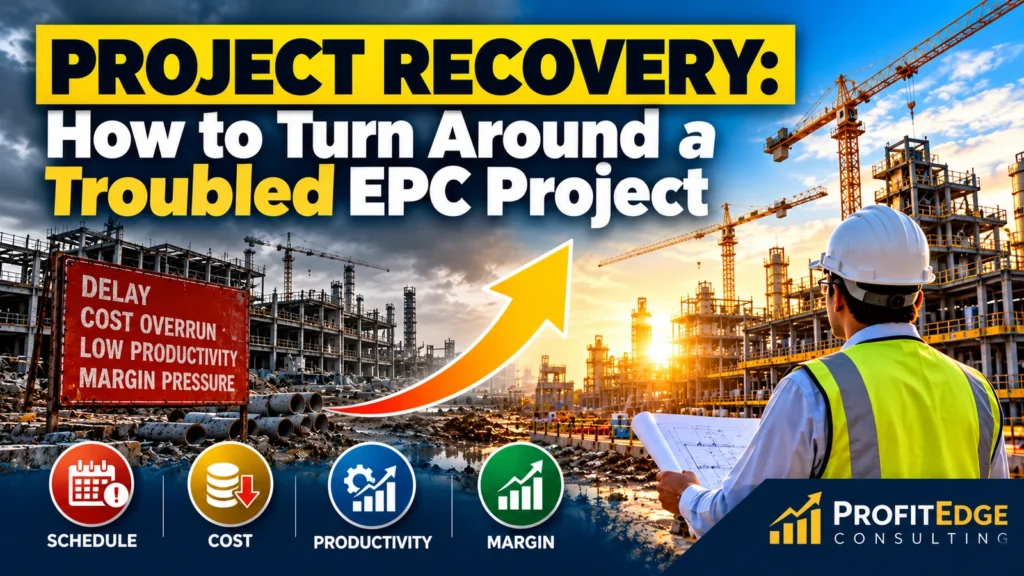
When an EPC or infrastructure project falls behind schedule, exceeds its budget and starts losing profitability, management needs more than another revised completion date. It needs a structured intervention to identify what has gone wrong, control the remaining expenditure and restore execution discipline.
A Project Recovery Consultant helps organisations identify the root causes of project underperformance, develop realistic recovery strategies, improve productivity and protect project margins. This specialist form of Project Recovery Consulting combines operational, commercial and financial interventions to restore control over troubled projects.
For EPC, construction, infrastructure, engineering and manufacturing companies, project recovery is not simply about completing delayed work. It is about understanding where time and money are being lost, determining what can realistically be recovered and ensuring that corrective actions produce measurable business results. A Capital Project Recovery Consultant brings this structured approach to complex, high-value projects where schedule slippage and cost escalation can put contract margins and cash flow at risk.
A project may appear 80% complete, yet the remaining work may involve significant engineering, procurement, integration, commissioning and financial risks. Without an accurate assessment, management may underestimate the cost of completion and overestimate the potential for recovery.
This guide explains how a Project Recovery Consultant approaches troubled projects, the seven steps involved in project recovery, how to develop a 30–60–90-day recovery plan and how management can protect project profitability.
Is Your EPC Project Delayed or Over Budget?
Identify cost overruns, execution bottlenecks, productivity losses and margin risks. Start with a structured discussion about your project’s current position, remaining scope and recovery priorities.
Explore Project Recovery Services →Project recovery is not simply about issuing a new completion date. It is a fact-based intervention to verify the remaining work, understand the cost to complete, remove execution bottlenecks and protect the final project margin.
What Does a Project Recovery Consultant Do?
A Project Recovery Consultant provides independent management support to organisations facing delayed, over-budget or underperforming projects.
The primary responsibility is to establish the actual project position, identify the causes of underperformance and help management implement corrective actions.
A structured project recovery engagement generally covers:
- Project schedule and milestone assessment.
- Cost overruns and cost-to-complete analysis.
- Engineering and procurement bottlenecks.
- Site productivity and resource utilisation.
- Contractor and subcontractor performance.
- Project planning and execution weaknesses.
- Commercial variations, claims and contractual exposure.
- Unbilled revenue and delayed collections.
- Cash-flow problems and margin erosion.
- Management reporting and accountability.
Unlike routine project monitoring, a Project Recovery Consultant focuses on identifying why existing management controls are not delivering the required results.
The objective is to establish a realistic recovery baseline, prioritise the most important interventions and monitor their impact on schedule, cost, productivity and profitability.
Project recovery does not necessarily mean achieving the original completion date at any cost. It means finding the most commercially and operationally viable route forward.
For businesses requiring specialist support, explore Project Recovery Services for EPC and Infrastructure Projects.
7 Warning Signs Your Project Needs a Project Recovery Consultant
Project problems rarely become serious overnight. Usually, several warning signs appear before management recognises the full financial impact.
A Project Recovery Consultant can help identify these warning signs and establish whether the project needs a formal recovery intervention.
1. Repeated project schedule delays
Key milestones are missed despite repeated schedule revisions.
Engineering, procurement and construction activities are not properly coordinated, and the critical path continues to deteriorate.
A revised completion date without a realistic execution strategy is not a recovery plan.
2. Project costs are increasing beyond the budget
Actual expenditure and outstanding commitments are increasing faster than planned.
However, management may still be relying on the original budget instead of a realistic forecast of the final project cost.
A Project Recovery Consultant should examine actual expenditure, purchase commitments, subcontractor liabilities and the estimated cost of completing the remaining scope.
3. Site productivity is declining
Labour and equipment are deployed, but completed work does not match the resources consumed.
Possible reasons include:
- Incomplete engineering drawings.
- Material shortages.
- Poor work-front planning.
- Equipment downtime.
- Subcontractor coordination problems.
- Excessive rework.
- Idle resources and waiting time.
Increasing manpower without resolving these constraints can increase expenditure without improving output.
4. Procurement and engineering delays are affecting execution
Critical materials arrive late. Technical queries remain unresolved. Drawings and approvals are not available when required.
These problems can disrupt dependent activities and create a chain reaction throughout the project.
5. Project profitability is declining
A project may continue generating revenue while its expected margin deteriorates.
Common reasons include unpriced variations, excessive overtime, rework, subcontractor claims, poor material utilisation and acceleration expenses.
Management must understand not only how much work has been completed but also how much profit is likely to remain at completion.
6. Cash flow is under pressure
Completed work is not being billed promptly. Client certifications are delayed. Collections are slow, and unbilled revenue continues accumulating.
The business may be funding project execution without receiving cash at the expected rate.
7. Management cannot establish the actual project position
Different departments report different progress figures. Cost forecasts are unreliable. Recovery actions remain overdue.
Senior management cannot confidently answer three important questions:
- When can the project realistically be completed?
- What will the remaining work actually cost?
- What will the final project margin look like?
When several of these warning signs occur together, an independent project recovery assessment becomes important.
Why Do EPC and Infrastructure Projects Become Troubled?
EPC projects involve engineering, procurement, construction, commissioning, vendors, subcontractors and contractual obligations.
A problem in one function can affect the performance of several others.
The most common causes include:
Unrealistic project estimates: Initial cost and schedule assumptions may not adequately reflect technical complexity, site conditions and resource requirements.
Poor project planning: Activities may be scheduled without validating dependencies, work-front availability and procurement lead times.
Delayed engineering approvals: Incomplete drawings, technical queries and design changes can disrupt construction.
Procurement failures: Critical materials and equipment may not arrive according to the execution schedule.
Low site productivity: Labour, equipment and subcontractors may not deliver the expected output.
Weak cost controls: Actual expenditure may be monitored without properly forecasting the cost of the remaining work.
Commercial leakage: Variations, claims, delayed certifications and unbilled revenue may remain unresolved.
Ineffective management decisions: Important issues may remain pending because accountability and escalation mechanisms are unclear.
A Project Recovery Consultant investigates the relationship between these problems instead of treating every delay as an independent issue. Effective Troubled Project Recovery addresses the connected causes of underperformance rather than treating each symptom in isolation.
The objective is to correct the underlying causes rather than repeatedly responding to their symptoms.
How a Project Recovery Consultant Rescues a Troubled Project
A structured project recovery programme should address seven interconnected areas. The approach can form part of a wider Programme Recovery Consultant engagement when several linked projects or workstreams need coordinated intervention.
Step 1: Conduct a comprehensive project health assessment
The first task is to establish the actual project position.
Management should not depend entirely on reported progress percentages or routine project status reports.
The assessment should examine:
- Original and revised project schedules.
- Actual physical progress.
- Critical-path activities.
- Engineering deliverables and pending approvals.
- Procurement status and material availability.
- Contractor and subcontractor performance.
- Actual expenditure and outstanding commitments.
- Estimated cost to complete.
- Contractual milestones and variation claims.
- Billing, collections and cash-flow exposure.
- Quality, safety and operational risks.
An important mistake is treating physical completion as an accurate indicator of financial or operational completion.
For example, a project reporting 80% completion may still have substantial expenditure and technically complex activities remaining.
Commissioning, integration, testing and statutory approvals may account for a disproportionate share of the remaining effort.
The assessment should establish a credible picture of the remaining scope, risks, costs and delivery constraints.
A Project Recovery Consultant should also distinguish between reported progress and verified physical achievement. This is essential when the existing project reporting system does not provide reliable information.
Step 2: Identify the root causes of project underperformance
After establishing the actual position, management needs to understand why the project has deteriorated.
Consider an EPC project experiencing construction delays.
The immediate assumption may be insufficient manpower.
However, a detailed investigation may reveal that:
- Engineering drawings were issued late.
- Materials were not available.
- Work fronts were not released.
- Subcontractors were working without proper coordination.
- Equipment was underutilised.
Simply adding more workers will not solve these problems.
A structured root-cause analysis should identify:
| Area | What to investigate |
|---|---|
| Engineering | Drawings, design changes and approvals |
| Procurement | Material availability and vendor delays |
| Construction | Work-front readiness and productivity |
| Resources | Labour, equipment and subcontractors |
| Cost | Actual expenditure and remaining cost |
| Commercial | Variations, claims and billing |
| Management | Decision delays and accountability |
Every major problem should have a corrective action, responsible owner, target date and measurable completion criterion.
The Project Recovery Consultant should prioritise problems according to their impact on completion, final cost, cash flow and contractual obligations.
Step 3: Develop a realistic project recovery schedule
A recovery schedule should demonstrate how the remaining work can be completed.
It should not simply replace the original completion date with another optimistic date.
The process should include:
- Validate the remaining project scope.
- Identify critical and near-critical activities.
- Establish engineering and procurement dependencies.
- Confirm resource and work-front availability.
- Review opportunities for parallel execution.
- Evaluate acceleration options.
- Assign responsibilities and milestones.
- Establish weekly progress monitoring.
Critical Path Method (CPM) analysis can help identify activities directly affecting project completion.
Earned Value Management (EVM), where supported by reliable underlying data, can improve visibility into schedule and cost performance.
The recovery schedule should also be resource-loaded so that labour, equipment, materials and subcontractor availability are consistent with the proposed execution plan.
A Project Recovery Consultant should challenge unrealistic productivity assumptions and ensure that proposed acceleration measures are commercially justified.
A realistic recovery date is more valuable than an attractive but unachievable commitment.
Step 4: Implement a 30–60–90-day project recovery action plan
A focused first 90 days can help management establish control and demonstrate whether corrective actions are working.
First 30 days: Stabilise the project
- Complete the project health assessment.
- Establish the actual critical path.
- Identify urgent procurement and engineering bottlenecks.
- Review cost-to-complete estimates.
- Identify major commercial and cash-flow risks.
- Assign recovery owners.
- Introduce weekly management reviews.
Days 31–60: Improve execution
- Implement revised work sequencing.
- Improve engineering, procurement and construction coordination.
- Resolve subcontractor performance issues.
- Improve labour and equipment productivity.
- Strengthen cost and variation controls.
- Monitor progress against recovery milestones.
Days 61–90: Validate the recovery trend
- Compare actual progress against the recovery baseline.
- Review cost and schedule forecasts.
- Identify unresolved constraints.
- Validate improvements in productivity.
- Reassess expected project margins.
- Modify corrective actions where necessary.
The Project Recovery Consultant should review the progress of every major corrective action and highlight unresolved decisions requiring senior management attention.
A 90-day action programme is an initial control mechanism. Complex EPC and infrastructure projects may require six to nine months or longer to achieve sustainable recovery.
Step 5: Improve site productivity and execution efficiency
Project recovery cannot succeed through additional manpower alone.
The objective should be to increase productive output from available resources.
Important improvement opportunities include:
- Ensuring complete work-front readiness.
- Coordinating drawings and material availability.
- Reducing equipment downtime.
- Improving daily work planning.
- Monitoring subcontractor performance.
- Reducing unnecessary movement and waiting time.
- Improving labour deployment.
- Reducing rework and quality failures.
- Improving coordination between site functions.
For example, if a construction crew cannot work because drawings and materials are unavailable, deploying additional workers will not improve output.
Resolving those constraints can improve productivity without unnecessarily increasing project costs.
Suitable indicators include installed quantities per crew-day, equipment utilisation, planned versus actual output and rework rates.
Safety and quality must remain non-negotiable throughout the recovery process.
A Project Recovery Consultant should ensure that productivity improvement measures are based on actual operating constraints rather than simply increasing work hours or resource deployment.
Step 6: Control project costs and protect profitability
Completing a project is not sufficient if the final commercial result is unacceptable.
Project recovery must address the financial consequences of underperformance. A focused Cost Recovery Consulting workstream examines avoidable expenditure, cost-to-complete assumptions, contractual entitlements and opportunities to prevent further margin erosion.
Improve cost-to-complete forecasting
Estimate the remaining expenditure for labour, materials, equipment, subcontractors, overheads and acceleration.
Control purchase commitments
Review outstanding purchase orders, subcontractor commitments and potential cost exposures.
Manage variations and claims
Identify changes in scope, contractual entitlements, delay responsibilities and pending claims.
Improve billing and collections
Ensure completed work is measured, certified and billed promptly.
Reduce avoidable expenditure
Investigate rework, idle resources, excessive overtime and material wastage.
Protect working capital
Monitor unbilled revenue, retention, delayed collections and supplier payment obligations.
A Project Recovery Consultant should also examine whether commercial opportunities are being missed because of weak documentation, delayed approvals or ineffective contract administration.
Related reading:
Illustrative example: How project recovery protects margins
Consider an EPC project with a contract value of ₹200 crore.
| Particulars | Amount |
|---|---|
| Contract value | ₹200 crore |
| Forecast final cost before corrective action | ₹190 crore |
| Expected profit | ₹10 crore |
| Expected margin | 5% |
Suppose a structured recovery exercise identifies ₹4 crore of avoidable cost exposure.
If management successfully prevents this expenditure without compromising scope, safety, quality or contractual obligations, the revised position becomes:
| Particulars | Amount |
|---|---|
| Contract value | ₹200 crore |
| Revised final cost | ₹186 crore |
| Revised expected profit | ₹14 crore |
| Revised margin | 7% |
Illustrative example only. These are not guaranteed savings or results.
The example demonstrates why project recovery must measure both schedule improvement and the financial impact of corrective action.
Step 7: Strengthen management governance and accountability
A recovery plan will not deliver results unless management ensures that corrective actions are implemented.
A practical review structure includes:
Daily site review
- Work-front availability.
- Labour and equipment deployment.
- Material shortages.
- Safety and execution constraints.
Weekly project recovery review
- Critical-path progress.
- Overdue activities.
- Procurement and engineering bottlenecks.
- Productivity.
- Recovery action completion.
Monthly executive review
- Forecast completion date.
- Cost at completion.
- Expected project margin.
- Cash-flow position.
- Contractual exposure.
- Major decisions requiring leadership intervention.
Every significant recovery action should have an owner, deadline and measurable outcome.
Management reviews should focus on decisions and corrective action rather than simply discussing historical performance.
The Project Recovery Consultant should provide management with a clear view of unresolved constraints, financial risks and the decisions required to keep the recovery programme on track.
Need an Independent Review of a Troubled Project?
ProfitEdge can help management assess schedule slippage, cost-to-complete, resource utilisation, cash-flow exposure and project margin risks, then prioritise practical recovery actions.
Review Project Recovery Services →How to Recover an EPC Project That Is 80% Complete but Over Budget
This is one of the most important situations for EPC management.
A project may report 80% physical completion, but it does not automatically follow that only 20% of the cost remains.
The remaining work may include:
- Complex mechanical and electrical integration.
- Pending engineering changes.
- Critical equipment installation.
- Testing and commissioning.
- Regulatory approvals.
- Performance guarantees.
- Outstanding subcontractor claims.
- Rectification and rework.
Consider an illustrative project with an original budget of ₹100 crore.
At 80% reported physical completion, management may assume that ₹20 crore is sufficient to finish the project.
However, if the remaining work, commitments and risks indicate that another ₹28 crore is required, the projected final cost becomes ₹108 crore.
The project is now facing an estimated ₹8 crore cost overrun.
Illustrative EPC Scenario: 80% Complete, but ₹8 Crore Over Budget
The reported completion percentage alone does not reveal the true cost of finishing the project. In this example, the remaining work is forecast to cost more than the original budget assumed.
Management implication: validate the remaining scope, commitments and cost-to-complete before approving further expenditure or setting a revised completion date.
Illustrative scenario only; not a ProfitEdge client case study or a guaranteed outcome.
The correct approach is to establish an updated Estimate at Completion (EAC).
Estimate at Completion = Actual Cost Incurred + Estimated Cost to Complete
This forecast should include relevant remaining commitments and expected cost exposures without double-counting them.
A Project Recovery Consultant can help management investigate the difference between the original estimate and the revised forecast, identify the reasons for the increase and determine which costs can still be controlled.
The objective is to understand the real financial position before additional resources are committed.
Need More Than a One-Time Project Review?
ProfitEdge offers remote business consulting support for CEOs and management teams. Engagement priorities can include project recovery, EPC performance improvement, PMO and project controls, EBITDA improvement, operational excellence, working capital and broader business performance.
Scope, deliverables, reporting rhythm and working arrangements are agreed before commencement.
A 6–9-Month Project Recovery Roadmap
Large EPC, infrastructure and industrial projects may need a longer recovery programme after the initial assessment.
The following is an illustrative roadmap.
| Phase | Timeline | Main objective |
|---|---|---|
| Project assessment | Weeks 1–2 | Establish actual project position |
| Recovery planning | Weeks 3–4 | Identify root causes and actions |
| Stabilisation | Months 2–3 | Resolve critical bottlenecks |
| Schedule and cost recovery | Months 3–5 | Improve execution and cost control |
| Margin and cash-flow improvement | Months 4–6 | Protect commercial performance |
| Sustained performance | Months 6–9 | Strengthen governance and controls |
The phases may overlap depending on the project.
A project facing procurement delays may stabilise relatively quickly, while one with major engineering deficiencies, contractual disputes or funding problems may require a longer intervention.
A six-to-nine-month roadmap is a planning framework, not a guaranteed recovery period.
Key KPIs to Monitor During Project Recovery
Management should use a concise dashboard to establish whether the recovery programme is producing measurable improvements.
| Performance area | Key indicator |
|---|---|
| Schedule | Critical-path variance |
| Cost | Forecast cost at completion |
| Productivity | Actual versus planned output |
| Procurement | Critical material availability |
| Engineering | Pending drawings and approvals |
| Quality | Rework and defect rates |
| Commercial | Variations and claims |
| Cash flow | Billing and collection performance |
| Governance | Overdue recovery actions |
Every KPI should have a baseline, reporting frequency, responsible owner and escalation threshold.
The purpose is to identify problems early rather than discovering them after the financial damage has occurred.
Project Recovery vs Routine Project Management
Routine project management focuses on delivering an approved project plan.
Project recovery focuses on restoring control when the existing management approach is no longer producing acceptable results.
| Area | Routine project management | Project recovery |
|---|---|---|
| Objective | Deliver approved plan | Restore project performance |
| Schedule | Monitor baseline | Revalidate critical path |
| Cost | Track expenditure | Reforecast final cost |
| Resources | Normal deployment | Targeted resource realignment |
| Governance | Standard reviews | Focused recovery reviews |
| Leadership | Routine oversight | Direct intervention on critical issues |
Project recovery should ultimately restore the controls, accountability and execution discipline required for effective routine project management.
Can Every Troubled Project Be Recovered?
No.
Some projects can be stabilised through better planning, stronger coordination and targeted investment.
Others may no longer be technically or commercially viable.
Before committing further resources, management should examine:
- Whether the remaining scope can be completed safely.
- Whether adequate funding is available.
- Whether contractual obligations remain achievable.
- Whether critical resources can be secured.
- Whether stakeholders will cooperate.
- Whether expected benefits justify remaining expenditure.
- Whether restructuring or stopping the project would produce a better outcome.
Continuing a failing project simply because substantial money has already been spent can increase losses.
A Project Recovery Consultant should help management evaluate future commercial viability rather than focusing only on historical expenditure.
Recovery decisions must be based on evidence, realistic assumptions and the best available commercial outcome.
When Should You Hire a Project Recovery Consultant?
Engaging a Project Recovery Consultant may be appropriate when:
- Your project repeatedly misses completion milestones.
- The final cost forecast keeps increasing.
- Actual site productivity is below expectations.
- Procurement and engineering delays are disrupting execution.
- Project margins are deteriorating.
- Unbilled revenue and delayed collections are creating cash-flow pressure.
- Internal reports do not provide a reliable picture of project performance.
- Management needs an independent assessment of recovery options.
Depending on the situation, an independent Project Rescue Consultant can support management through:
- Independent project health assessment.
- Root-cause analysis.
- Schedule and cost-to-complete review.
- Recovery planning and prioritisation.
- Productivity and resource improvement.
- Commercial and margin protection.
- Recovery monitoring and management reporting.
The scope may include an initial diagnostic assessment, preparation of a recovery roadmap or continuing implementation support. Project Recovery Consulting can be commissioned for a single troubled EPC contract, a major capital project or a portfolio of interdependent programmes.
The objective is not simply to prepare another report. It is to help management identify the problems that matter most and take measurable corrective action.
Organisations looking for specialist support can explore ProfitEdge Consulting's Project Recovery Services.
Do You Have a Clear View of Your Project’s Final Cost and Completion Date?
If cost forecasts keep changing or the recovery actions are not being implemented, an independent review can help management establish the facts and focus on the decisions that matter.
Discuss Your Project Recovery Needs →Frequently Asked Questions About Project Recovery Consulting
1. What does a Project Recovery Consultant do?
A Project Recovery Consultant assesses delayed, over-budget or underperforming projects, identifies root causes and helps management develop corrective actions to improve schedule, cost, productivity and profitability.
2. How do you recover a delayed or over-budget project?
Start by validating actual progress, remaining scope, expenditure and contractual commitments. Identify the root causes, prepare a realistic recovery schedule, resolve critical bottlenecks, improve productivity and monitor cost-to-complete forecasts.
3. What is a project recovery plan?
A project recovery plan is a structured document defining the corrective actions, responsibilities, resources, milestones and management controls required to restore project performance.
4. How long does project recovery take?
The duration depends on project complexity, the severity of underperformance, resource availability and contractual conditions. An initial assessment may take a few weeks, while complex EPC projects may require six to nine months or longer.
5. What are the main causes of troubled EPC projects?
Common causes include unrealistic estimates, weak planning, delayed engineering approvals, procurement bottlenecks, low site productivity, poor cost controls and unresolved commercial issues.
6. What should a project recovery plan include?
It should include a verified project baseline, root-cause findings, a realistic completion schedule, cost-to-complete forecast, prioritised corrective actions, accountable owners, deadlines, measurable KPIs and a regular management review process.
7. When should a company appoint an independent Project Recovery Consultant?
Consider an independent assessment when repeated delays, rising forecasts, low productivity, cash-flow pressure or conflicting progress reports prevent management from understanding the true project position.
8. Can project recovery improve profitability as well as delivery?
Yes, where the causes of margin erosion are controllable. Recovery work can improve cost forecasting, reduce avoidable expenditure, strengthen variation management, improve billing discipline and focus resources on the remaining critical work. Results depend on project conditions and implementation.
Take the Next Step: Establish the Real Position of Your Project
If your EPC or infrastructure project is delayed, over budget or losing margin, the first priority is to establish the facts: verified progress, remaining scope, cost to complete, critical constraints and commercial exposure.
ProfitEdge Consulting helps project-led businesses assess underperforming projects and develop practical recovery actions across schedule, cost, productivity, cash flow and profitability.
Start with the support that matches your immediate requirement. For a troubled EPC or infrastructure project, review the project-specific recovery service. For broader and continuing management support, explore the remote consulting engagement.
Request a Project Recovery Discussion Explore Remote Business Consulting Contact ProfitEdge
Services, deliverables and working arrangements are subject to the consulting agreement. Business outcomes are not guaranteed.

Vipin Gandhi
Vipin Gandhi is a business performance and turnaround consultant with extensive experience helping EPC, infrastructure, manufacturing and industrial businesses improve profitability, project performance and operational efficiency.
His expertise includes project recovery, EBITDA improvement, cost optimization, project controls, productivity improvement and business performance improvement.
Pingback: Business Consultant Near Me: Find the Right Expert
Pingback: Why Projects Go Over Budget: 9 Warning Signs
Pingback: Unbilled Revenue in EPC Projects: Hidden Cash Flow Risk