
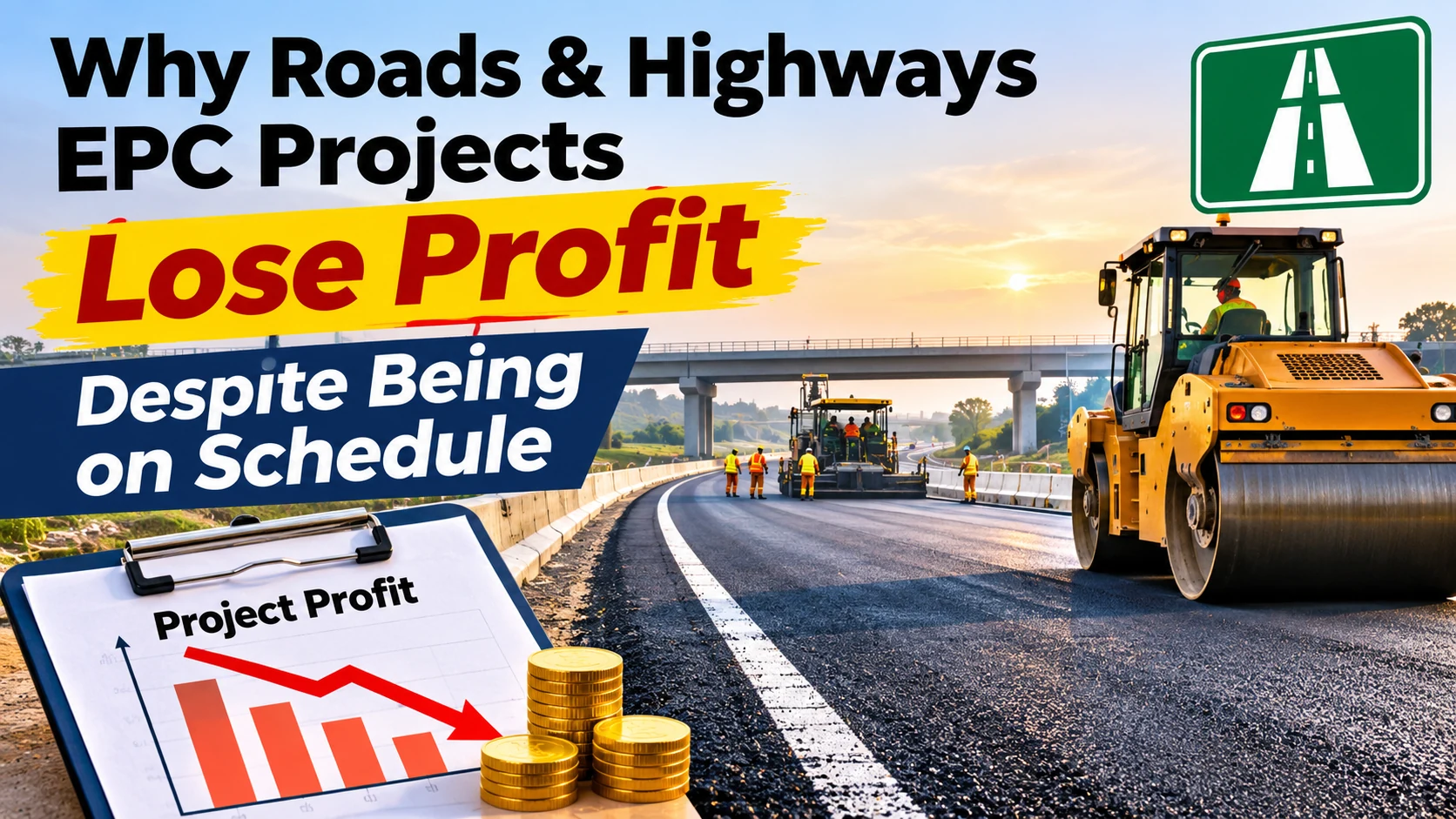
Your road project is progressing according to schedule. Construction targets are being achieved. Equipment is deployed. The client is satisfied with physical progress.
But there is a question your project dashboard may not be answering:
Is the project actually making the profit you expected?
A road or highway EPC project can remain on schedule and still lose money. The reason is simple: physical progress and financial performance are not the same thing.
Quantities may be higher than estimated. Borrow material may cost more. Equipment may be underutilised. Subcontractor productivity may be lower than planned. Design changes may consume additional resources. Work may be completed but not certified or billed.
By the time these problems appear in the final project accounts, the original margin may already have disappeared.
This is the hidden challenge of roads and highways EPC project profitability. The contractor may be delivering the project on time while the financial outcome quietly deteriorates.
1. Why Being on Schedule Does Not Guarantee Profit
Most road EPC companies track project performance through physical progress, milestone achievement, expenditure and construction output.
These indicators are necessary, but they do not reveal the entire commercial picture.
Consider a contractor executing a ₹200 crore highway package. The project is progressing on schedule, but the following problems are developing:
- Actual earthwork quantities are higher than the original estimate.
- Aggregate and bitumen procurement costs are above the budget.
- Crushers, hot-mix plants and pavers are not achieving planned utilisation.
- Subcontractor productivity is below the estimated level.
- Additional work has been carried out without timely variation approval.
- Completed work is waiting for measurement, certification and billing.
None of these issues necessarily makes the project late. But each can reduce the contractor's contribution margin.
That is why roads and highways EPC project profitability must be monitored independently of schedule performance.
2. Where Does Profit Actually Disappear in Road and Highway EPC Projects?
Profit leakage often develops through small operational inefficiencies that accumulate over the project lifecycle.
For management, the challenge is not merely identifying these issues. It is measuring their financial impact early enough to take corrective action.
3. The Biggest Hidden Risk: Your Actual Quantities May Be Different from Your Bid Quantities
Road construction is highly dependent on quantities, site conditions, geological characteristics, design parameters and approved drawings.
A contractor may prepare a bid using the available DPR, drawings, soil investigations and BOQ. During execution, actual conditions may reveal significant differences.
Examples include:
- Additional earthwork because of actual ground conditions.
- Changes in embankment height or formation levels.
- Unexpected soil treatment or stabilisation requirements.
- Additional drainage and protection works.
- Changes in pavement layer thickness or material requirements.
- Additional structures, retaining works or utility-related activities.
Suppose the contractor has estimated a particular quantity of earthwork at a specific unit cost. If actual quantities increase, the financial impact depends on the applicable BOQ rates, contractual measurement rules, approval and scope provisions.
A strong quantity-control system should compare four figures:
- Original bid quantity.
- Approved drawing or revised quantity.
- Actual executed quantity.
- Measured, certified and payable quantity.
Without this reconciliation, a road EPC company may report physical progress without knowing whether the work is commercially protected.
4. Equipment Utilisation: The Profit Killer That Often Goes Unnoticed
Road and highway construction requires significant investment in equipment and plant.
Depending on project scope, the contractor may deploy:
- Excavators and wheel loaders.
- Motor graders and bulldozers.
- Vibratory rollers and soil compactors.
- Stone crushers and screening plants.
- Wet mix macadam plants.
- Hot-mix plants and asphalt pavers.
- Transit mixers, tippers and water tankers.
Management often tracks equipment availability. But availability is not the same as productive utilisation.
Illustrative equipment utilisation example
Assume a highway contractor operates a crusher plant with a planned output of 400 tonnes per day.
| Parameter | Planned | Actual |
|---|---|---|
| Daily output | 400 tonnes | 280 tonnes |
| Operating days | 25 | 25 |
| Monthly production | 10,000 tonnes | 7,000 tonnes |
| Output shortfall | — | 3,000 tonnes |
The plant has achieved only 70% of planned output.
Possible causes include:
- Insufficient work-front availability.
- Breakdowns and delayed maintenance.
- Power interruptions or fuel constraints.
- Inadequate feed material or poor material quality.
- Transportation bottlenecks.
- Weak coordination between crushing, stockpiling and laying operations.
The result may be a higher cost per tonne, delayed material availability and pressure on the project's contribution margin.
5. Material Cost Escalation: Are Your Procurement Rates Eating into the Margin?
Material cost is a major component of many road and highway EPC contracts.
Bitumen, aggregates, sand, cement, steel, diesel and other construction inputs can have a significant effect on project economics.
Consider these situations:
- The nearest approved aggregate source is exhausted and a more distant source is required.
- Transportation distance increases because of restrictions or route changes.
- Bitumen procurement rates change during the execution period.
- Material quality is rejected, requiring replacement.
- Procurement is delayed and emergency purchases become necessary.
- Inventory is purchased too early or too late, increasing financing or supply risks.
Price adjustment provisions, where applicable, may help address certain changes in input prices. However, the actual contractual formula, eligible inputs, base date, index, thresholds and documentation requirements must be checked.
A contractor should not assume that every cost increase will automatically be reimbursed.
To improve roads and highways EPC project profitability, management should review material cost at three levels:
- Budgeted cost per unit.
- Actual procurement and delivered cost per unit.
- Forecast cost of the remaining quantities.
6. The ₹200 Crore Highway Project: How Can Profit Disappear Without a Schedule Delay?
Consider an illustrative road EPC project with a contract value of ₹200 crore.
The contractor originally estimated the project cost at ₹184 crore and expected a contribution of ₹16 crore.
| Particulars | Original estimate | Revised forecast |
|---|---|---|
| Contract value | ₹200 crore | ₹200 crore |
| Estimated project cost | ₹184 crore | ₹190 crore |
| Expected contribution | ₹16 crore | ₹10 crore |
| Contribution margin | 8.0% | 5.0% |
Assume the following illustrative cost increases:
| Source of profit leakage | Additional cost |
|---|---|
| Higher material and transportation costs | ₹1.50 crore |
| Equipment underutilisation | ₹1.00 crore |
| Additional labour and subcontractor costs | ₹1.20 crore |
| Rework and quality-related costs | ₹0.80 crore |
| Extended site overhead and financing costs | ₹1.50 crore |
| Total additional cost | ₹6.00 crore |
The original expected contribution was ₹16 crore. After the additional ₹6 crore of costs, the forecast contribution falls to ₹10 crore.
₹6 Crore Profit Leakage
Original contribution: ₹16 crore
Revised contribution: ₹10 crore
Reduction in expected contribution: 37.5%
The project can remain on schedule while losing more than one-third of its planned contribution.
This is why roads and highways EPC project profitability needs continuous cost forecasting, not merely monthly expenditure reporting.
The example is illustrative and does not represent an actual ProfitEdge client project or an industry benchmark.
7. Change of Scope and Extra Items: Are You Getting Paid for Everything You Execute?
Highway projects may encounter changes in quantities, design, site conditions, structures, drainage, utility interfaces and other work requirements.
Some changes may be covered by the original BOQ or contract provisions. Others may require formal change-of-scope approval or a separate valuation process.
The commercial risk is that site teams may execute additional work to maintain progress without ensuring that the required contractual process is followed.
Typical warning signs include:
- Instructions received verbally but not formally recorded.
- Additional quantities executed without timely measurement.
- New items without agreed rates.
- Variation proposals submitted late.
- Design revisions not reflected in the latest cost forecast.
- Disagreement over the applicable schedule of rates or valuation basis.
The Ministry of Road Transport and Highways' standard EPC agreement provides a framework for change-of-scope proposals, including quantity breakdowns, unit rates, cost and schedule impacts.
Contractors should review the exact agreement applicable to their project rather than assume every highway contract contains identical provisions.
Reference: MoRTH – Revised Standard EPC Agreement for National Highway and centrally sponsored road works.
8. Working Capital: The Profit You Earn on Paper May Not Be Available in Your Bank Account
A road EPC contractor may report project revenue and expected contribution, yet still face serious cash-flow pressure.
This can happen when:
- Executed quantities are awaiting measurement.
- Running Account bills are submitted late.
- Certified bills remain unpaid.
- Retention money is accumulating.
- Material advances and mobilisation advances are not being adjusted as planned.
- Subcontractor payments are due before client collections arrive.
- Disputed quantities remain unresolved.
Working capital costs can quietly reduce roads and highways EPC project profitability, particularly when multiple projects are being executed simultaneously.
Illustrative working-capital exposure
Assume an EPC contractor has ₹20 crore tied up in delayed receivables and unbilled work. If the effective annual financing cost is 12%, the simple annual financing exposure is:
₹2.40 Crore per year
₹20 crore × 12% = ₹2.40 crore
This is an illustrative financing calculation, not a claim that the full amount is automatically an accounting expense or recoverable from the client.
The CEO and CFO should review unbilled revenue, receivable ageing, retention, certification delays and cash conversion for every major project.
Related reading: Unbilled Revenue and Delayed Collections: The Hidden Cash Flow Problem.
9. Highway Project Delays and Cost Escalation: What Does Government Data Tell Us?
Project execution challenges in the highway sector are not limited to contractor productivity. Land acquisition, statutory approvals, utility shifting, encroachment removal, law-and-order issues, financing constraints and contractor performance can all affect project delivery.
In a Rajya Sabha reply dated 18 March 2026, the Ministry of Road Transport and Highways stated that 85 under-construction National Highway projects were delayed by more than three years. The Ministry identified multiple contributing factors, including land acquisition, clearances, utility shifting, encroachment removal and financial or execution difficulties.
In another Rajya Sabha reply dated 10 December 2025, the Ministry discussed cost escalation factors such as higher land and structure compensation, price escalation, GST changes, additional facilities and design changes to structures.
These figures relate to government-reported National Highway project delays and cost escalation. They should not be interpreted as the percentage of private EPC contractors losing profit.
Official references:
- Rajya Sabha – Delays in Projects Due to Land Acquisition, 18 March 2026
- Rajya Sabha – Delay in National Highway Projects, 10 December 2025
- Ministry of Road Transport and Highways – Completion of National Highway Projects
10. Seven Actions Every Roads & Highways EPC CEO Should Take
Action 1: Introduce project-level cost-to-complete forecasting
Do not rely only on the original project budget or expenditure incurred to date.
For every major BOQ item, track:
- Original estimated quantity and cost.
- Actual executed quantity and cost.
- Remaining quantity.
- Committed procurement and subcontractor cost.
- Forecast final cost.
- Expected contribution at completion.
Action 2: Measure equipment productivity daily
Track output per machine, operating hours, idle hours, fuel consumption, breakdown hours and maintenance costs.
Equipment productivity should be connected to actual construction output—not simply machine deployment.
Action 3: Establish a material-cost control system
Review procurement rates, delivered costs, lead distances, wastage, inventory levels and consumption norms.
Compare actual consumption per unit of completed work with the approved technical and budget assumptions.
Action 4: Reconcile executed quantities with certified quantities
Prepare a regular reconciliation of BOQ quantities, site measurements, executed quantities, certified quantities and billed quantities.
Every material difference should have an owner and a closure date.
Action 5: Strengthen subcontractor performance management
Review subcontractor productivity, work quality, rate structure, resource deployment, output commitments and payment terms.
Commercial control should begin before the subcontractor's final bill arrives.
Action 6: Protect variations and contractual claims
Maintain a change register with formal instructions, measurements, approvals, cost impact, time impact and claim status.
Ensure contractual notices and supporting records are submitted within the time limits applicable to the agreement.
Action 7: Conduct a monthly project profitability review
The CEO, CFO, project director, commercial head, procurement head and planning head should jointly review the expected final margin.
The discussion should focus on financial outcomes, not just construction progress.
11. The Roads & Highways EPC Dashboard Every CEO Should Demand
A useful project dashboard should combine physical execution, cost, commercial performance and cash flow.
| KPI | What it measures | CEO's question |
|---|---|---|
| Physical progress | Actual construction progress against baseline | Are we delivering the planned output? |
| Cost performance | Actual cost against budget | Are we spending more than planned? |
| Cost to complete | Forecast remaining project expenditure | What will the final project cost be? |
| Quantity variance | Bid, approved, executed and certified quantities | Where are quantities changing? |
| Equipment utilisation | Productive hours and output per machine | Are our assets earning their cost? |
| Material consumption | Actual material use per unit of output | Where is material wastage occurring? |
| Variation status | Pending and approved change-of-scope items | Are additional works commercially protected? |
| Unbilled revenue | Completed work not yet billed | Why is completed work not converted into billing? |
| Receivable ageing | Outstanding client collections | Which payments require escalation? |
| Forecast contribution | Expected final project contribution | Are we protecting the original margin? |
This is the foundation of effective roads and highways EPC project profitability management.
12. Five Mistakes That Cause Road EPC Companies to Lose Profit
- Celebrating physical progress without financial progress: A project can be on schedule while its cost forecast deteriorates.
- Using the original budget throughout execution: The budget is a starting point, not a substitute for a realistic estimate at completion.
- Ignoring equipment idle time: Expensive machines may remain deployed without generating sufficient output.
- Executing additional work without commercial closure: Delayed approvals and incomplete records can create disputes over payment.
- Reviewing project accounts too late: Monthly financial statements may reveal problems after the opportunity for operational correction has passed.
13. A 10-Point CEO Checklist for Every Highway EPC Project
Ask your project team these questions at the next review:
- Is the latest cost-to-complete forecast available?
- Are actual quantities reconciled with bid and approved quantities?
- Which BOQ items have the largest negative cost variance?
- Are crushers, pavers, graders and other major equipment achieving planned utilisation?
- Is material consumption within approved norms?
- Are subcontractor costs and productivity under control?
- Are all additional works supported by the required records and approvals?
- How much executed work remains unbilled or uncertified?
- What is the current working-capital exposure?
- What is the revised project contribution at completion?
If the team cannot answer these questions with reliable data, the organisation may have a project-control and profitability visibility problem.
14. Conclusion: A Project Delivered on Time Is Not Necessarily a Profitable Project
Road and highway EPC companies operate in a competitive environment where bid pricing, quantities, material procurement, equipment productivity, subcontractor performance and working capital all influence the final financial result.
Completing a project on schedule is important. But it is only one dimension of project success.
To protect roads and highways EPC project profitability, management must monitor the financial outcome throughout execution.
The priorities are clear:
- Measure project contribution, not just physical progress.
- Forecast final cost instead of relying on the original budget.
- Control quantities, material consumption and equipment productivity.
- Protect contractual variations and additional work.
- Convert executed work into certified billing and collections.
- Review project profitability at the CEO level every month.
Is Your EPC Business Growing Revenue but Losing Project Margins?
ProfitEdge Consulting helps EPC and infrastructure businesses identify profitability leakages, improve project controls, strengthen cost management and improve business performance.
Evaluate the gaps affecting your project contribution, cash flow and EBITDA.
Request a Business Performance Assessment Contact ProfitEdge ConsultingFrequently Asked Questions
1. Why do road and highway EPC projects lose profit even when they are on schedule?
They may lose profit because of higher material costs, inaccurate quantity estimates, equipment underutilisation, low labour productivity, subcontractor overruns, rework, unapproved variations and working-capital costs. Schedule performance alone does not measure final project contribution.
2. What are the biggest cost overruns in highway EPC projects?
Common cost pressures include earthwork quantity variations, aggregates and bitumen costs, transportation, equipment operating costs, subcontractor expenses, rework, structures, drainage and additional scope. The actual cost drivers depend on the project and contract.
3. How can a highway EPC contractor improve project profitability?
Contractors can improve profitability by forecasting cost to complete, controlling quantities, improving equipment utilisation, reducing material wastage, managing subcontractor productivity, protecting variations and accelerating billing and collections.
4. How does equipment underutilisation affect road construction profitability?
Underutilisation increases the cost per unit of output because equipment ownership, depreciation, financing, maintenance and deployment costs continue even when productive output is low.
5. What is cost to complete in an EPC project?
Cost to complete is the forecast expenditure required to finish the remaining project scope. It should include remaining work, committed procurement, subcontractor obligations, site overheads, risk allowances and other expected costs.
6. How can EPC companies control material cost escalation?
They should monitor delivered procurement rates, transportation distances, consumption norms, wastage, inventory and contractual price-adjustment provisions. Procurement decisions should be linked to actual site demand and approved specifications.
7. Why is working capital important in road EPC projects?
Delayed measurements, certification, billing and collections can create a funding gap. The contractor may need to finance labour, suppliers and subcontractors before receiving payment, increasing interest costs and cash-flow pressure.
8. What KPIs should a road EPC CEO review every month?
Key indicators include physical progress, cost variance, estimate at completion, quantity variance, equipment utilisation, material consumption, variation status, unbilled revenue, receivable ageing and forecast contribution margin.
9. What is the difference between project progress and project profitability?
Project progress measures how much work has been completed. Project profitability measures the financial contribution expected or achieved after accounting for project revenue and costs. A project can progress on schedule while its final margin declines.
10. How can a business performance consultant help a road EPC company?
A consultant can assess project cost control, quantity management, equipment productivity, procurement, working capital, commercial processes and management reporting. The objective is to identify measurable performance gaps and implement corrective actions.
About the Author

Founder & Principal Consultant, ProfitEdge Consulting
35+ years of industry and consulting experience in business performance improvement, project execution, cost optimisation and profitability enhancement.