
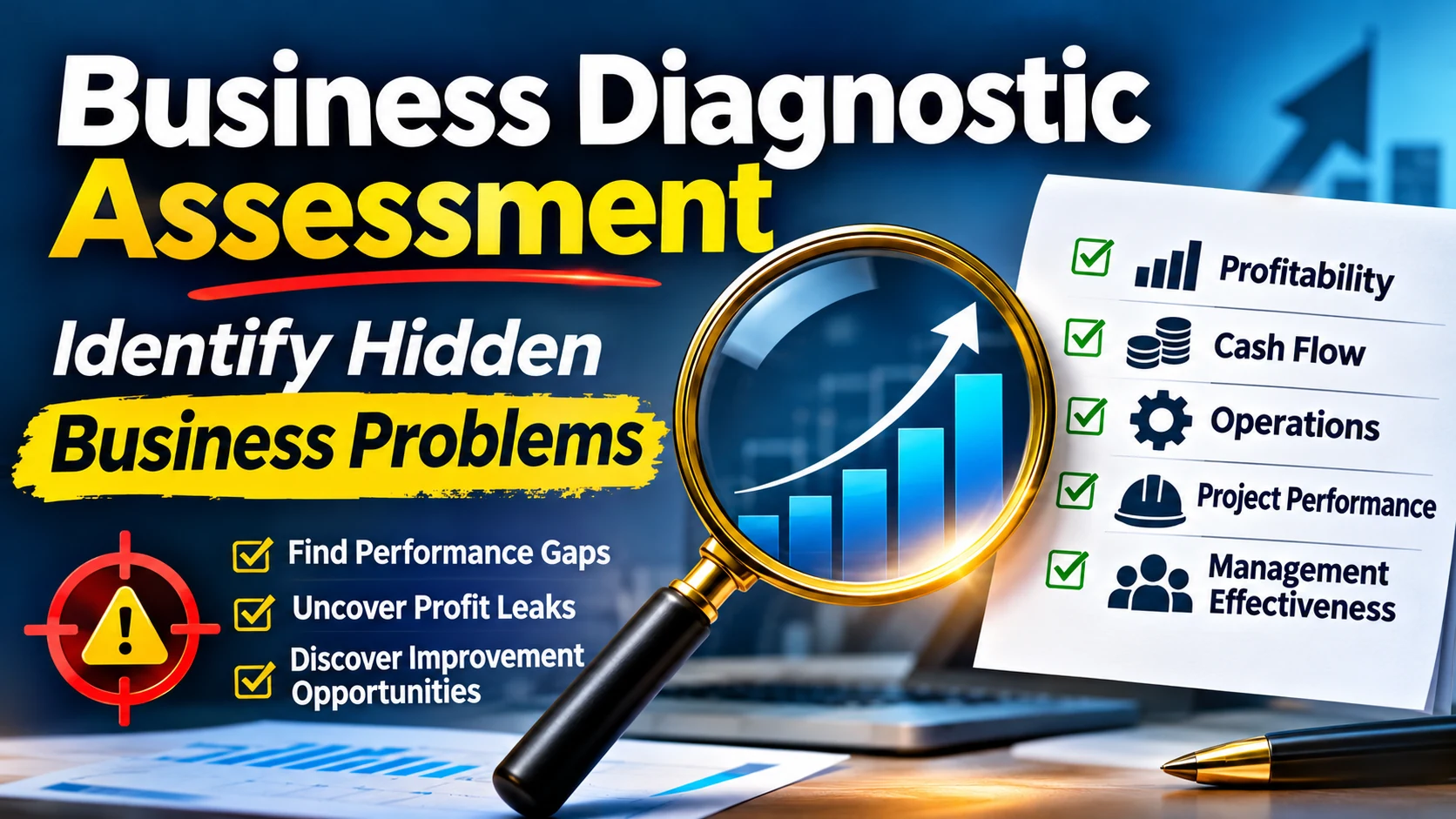
Business Diagnostic Assessment: Identify Hidden Business Problems
Your business may be generating substantial revenue, winning new orders and expanding its operations. But are you certain that it is converting this growth into sustainable profit and cash flow?
Many businesses experience declining margins, rising working capital requirements, delayed collections, operational inefficiencies and weak project controls without identifying the underlying causes. These problems often remain hidden until they begin affecting profitability, liquidity and business growth.
A structured Business Diagnostic Assessment helps business owners, CEOs and managing directors identify these issues, understand their financial and operational impact, and prioritise corrective actions.
It examines the business beyond its profit and loss statement. It looks at how revenue is generated, where margins are lost, how cash is used, how efficiently resources are deployed and whether management systems are delivering the expected results.
- Where your business is losing profitability.
- Why revenue growth may not be translating into cash flow.
- Which customers, products or projects are generating inadequate returns.
- Where operating costs and working capital are increasing.
- Which operational and management issues require immediate attention.
- What actions can improve business performance and profitability.
1. What Is a Business Diagnostic Assessment?
A Business Diagnostic Assessment is a structured evaluation of a company's financial performance, profitability, operational efficiency, working capital, project execution and management systems.
Its purpose is to identify the gaps between expected business performance and actual results. It also helps determine the underlying reasons for those gaps and the opportunities available to improve performance.
Unlike a conventional financial review that primarily examines historical financial statements, a comprehensive business diagnostic connects financial outcomes with the operational and managerial activities that create them.
Business diagnosis versus financial reporting
| Financial reporting | Business diagnostic assessment |
|---|---|
| Reports revenue and expenses. | Examines what drives revenue and expenses. |
| Shows reported profitability. | Identifies where and why margins are being lost. |
| Reports receivables and payables. | Investigates collection delays and working capital blockages. |
| Shows inventory balances. | Examines slow-moving and excess inventory. |
| Reports project costs. | Investigates cost overruns, productivity and execution gaps. |
| Summarises historical results. | Prioritises actions to improve future performance. |
The objective is not simply to identify what went wrong. It is to establish what needs to change, who should take responsibility and how improvement can be measured.
2. Why Businesses Need a Diagnostic Assessment
A business can appear financially healthy while important performance problems remain hidden. Revenue may be increasing, but margins may be declining. The order book may be growing, but projects may be consuming more cash than expected.
These problems become particularly important in manufacturing, EPC, infrastructure, engineering, construction, industrial services and project-based businesses.
Common reasons for declining business performance
- Revenue without adequate margins: Sales growth may be driven by low-margin customers, products or contracts.
- Rising operating expenses: Employee costs, logistics, energy, subcontracting and overheads may be increasing faster than revenue.
- Cash trapped in operations: Receivables, unbilled revenue and inventory may absorb increasing amounts of working capital.
- Weak project controls: Actual project costs may exceed estimates because of inadequate monitoring and cost forecasting.
- Low resource utilisation: Machinery, labour, facilities and other assets may not be generating their full potential output.
- Inadequate management information: Management may receive financial information too late to take corrective action.
- Unclear accountability: Business targets may exist without clear ownership and measurable responsibilities.
Growth does not automatically mean better business performance.
A company can increase turnover while its operating margin declines, cash flow deteriorates and management complexity increases. A proper diagnostic examines the relationship between growth, profitability, cash generation and operational performance.
3. 10 Critical Areas Examined in a Business Diagnostic Assessment
An effective Business Diagnostic Assessment should examine the interconnected areas that influence business performance. The following ten areas provide a practical framework.
1. Revenue Quality and Growth
The assessment examines whether revenue growth is sustainable and commercially attractive.
- Revenue growth by product, service, customer and business unit.
- Customer concentration and dependence on major accounts.
- Order book quality and conversion into revenue.
- Sales pipeline quality and order conversion.
- Revenue leakage, billing delays and unbilled work.
The objective is to distinguish profitable, sustainable growth from revenue that creates additional operating pressure without adequate returns.
2. Profitability and EBITDA Performance
A company may report healthy sales but still experience weak operating profitability. The diagnostic examines the factors affecting gross margin, operating profit and EBITDA.
- Gross profit and contribution margins.
- EBITDA margin trends.
- Profitability by product, customer and project.
- Direct and indirect cost structures.
- Overhead absorption and cost allocation.
- Variations between budgeted and actual profitability.
The analysis helps identify where profitability is being eroded and which improvement opportunities deserve management attention.
3. Working Capital and Cash Flow
Profit on paper does not necessarily translate into cash in the bank. Working capital problems can restrict growth and increase dependence on external funding.
- Debtor ageing and overdue receivables.
- Unbilled revenue and delayed invoicing.
- Inventory levels and slow-moving stock.
- Supplier payment terms and creditor management.
- Advances, retention money and security deposits.
- Cash conversion cycle and operating cash flow.
For a deeper understanding, read our guide to Working Capital Management and the analysis of Unbilled Revenue and Delayed Collections.
4. Cost Structure and Cost Optimisation
The assessment identifies avoidable costs, inefficient spending patterns and opportunities to improve cost competitiveness without damaging business capability.
- Material and procurement costs.
- Labour and manpower productivity.
- Energy, logistics and transportation costs.
- Subcontracting and outsourcing expenses.
- Administrative and corporate overheads.
- Budgetary control and cost accountability.
5. Operational Efficiency and Productivity
Operational inefficiencies can reduce output, increase costs and delay customer deliveries.
- Capacity utilisation and equipment availability.
- Production planning and scheduling.
- Machine downtime and maintenance practices.
- Material wastage and rework.
- Labour productivity and process efficiency.
- Quality failures and rejection rates.
For manufacturing and industrial companies, these indicators help connect operational performance with profitability.
6. Project Performance and Execution
For EPC, infrastructure, construction and engineering companies, project performance is a major determinant of overall business profitability.
- Estimated cost versus actual cost.
- Project-wise revenue and margin performance.
- Schedule delays and their financial consequences.
- Equipment and manpower utilisation.
- Subcontractor performance.
- Change orders, variations and claims.
- Billing milestones and collection status.
- Cost-to-complete forecasts.
A project can be substantially complete and still suffer significant financial losses if remaining costs, claims, variations and billing obligations are not properly monitored.
Explore EPC Performance Improvement and Project Recovery Services for more detailed guidance.
7. Customer and Product Profitability
Not every customer or product contributes equally to business profitability. High-revenue accounts may consume more resources than their margins justify.
- Customer-wise contribution margins.
- Product and service profitability.
- Discounting and pricing practices.
- Cost of servicing individual customers.
- Returns, warranty and after-sales costs.
- Customer retention and commercial terms.
The aim is to understand which customers, products and services create sustainable value.
8. Organisation and Management Effectiveness
Business performance depends on how effectively responsibilities, decisions and resources are managed.
- Organisation structure and role clarity.
- Decision-making authority and escalation systems.
- Management review frequency.
- Performance accountability.
- Coordination between departments.
- Leadership bandwidth and management capability.
9. Business Planning and Management Information Systems
A business needs timely and reliable information to identify performance gaps and take corrective action.
- Annual budgets and business plans.
- Monthly performance reviews.
- Budget versus actual reporting.
- Department-wise and project-wise dashboards.
- Forecasting and variance analysis.
- Management reporting accuracy and timeliness.
10. Growth Opportunities and Strategic Priorities
The diagnostic also examines whether the business is allocating its resources towards the right opportunities.
- High-potential products and markets.
- Customer and sector concentration risks.
- Capacity expansion and investment priorities.
- New business opportunities and commercial viability.
- Capital allocation and return on investment.
- Short-term and long-term performance priorities.
Want to identify performance gaps in your business?
Start with the free Executive Business Performance Assessment™ to identify areas that may need closer management attention.
Start Free Assessment4. Warning Signs Your Business Needs a Diagnostic Assessment
A formal diagnostic becomes especially valuable when management observes recurring problems but does not have a clear understanding of their root causes.
| Business warning sign | What it may indicate |
|---|---|
| Revenue is growing but profit is stagnant. | Margin erosion, cost escalation or poor revenue quality. |
| Bank borrowing is increasing despite reported profits. | Working capital blockages or weak cash conversion. |
| Receivables are rising faster than sales. | Collection delays, billing disputes or weak credit control. |
| Projects are repeatedly exceeding budgets. | Estimation gaps, inadequate cost controls or execution problems. |
| Inventory keeps increasing. | Poor demand planning, procurement or stock management. |
| Overheads are increasing without proportional output. | Low productivity or organisational inefficiencies. |
| Management receives reports too late. | Weak MIS and delayed performance visibility. |
| Different departments blame each other for results. | Unclear ownership and inadequate accountability. |
| New orders are not improving cash flow. | Unfavourable contract terms or cash-intensive execution. |
One warning sign may not necessarily indicate a serious problem. However, multiple recurring symptoms usually justify a closer examination of business performance.
5. How a Business Diagnostic Assessment Works
A structured assessment should move from information gathering to analysis, identification of improvement opportunities and prioritisation of corrective actions.
Step 1: Understand the Business
Understand the company's business model, industry, products, customers, operating structure, revenue streams and strategic priorities.
Step 2: Review Financial and Operational Information
Examine relevant financial statements, management reports, budgets, receivables, inventory, cost data, project reports and operational information, depending on the agreed scope.
Step 3: Identify Performance Gaps
Compare actual results with budgets, historical trends, management targets and relevant operating expectations.
Step 4: Investigate Root Causes
Identify the underlying financial, commercial, operational and management factors responsible for performance gaps.
Step 5: Estimate Improvement Opportunities
Evaluate potential opportunities relating to profitability, working capital, cost optimisation, productivity, project controls and resource utilisation.
Step 6: Prioritise Corrective Actions
Prioritise actions according to financial impact, urgency, feasibility, implementation effort and management responsibility.
Step 7: Establish Performance Monitoring
Define measurable KPIs, review frequency, accountability and reporting mechanisms to track progress.
6. Illustrative Example: Diagnosing a ₹100 Crore Business
Consider a hypothetical company with annual revenue of ₹100 crore. Management believes the business is performing reasonably well because sales have remained stable. However, cash flow is under pressure and the company is increasingly dependent on working capital finance.
A diagnostic review may reveal the following illustrative performance picture:
| Performance indicator | Illustrative observation | Potential concern |
|---|---|---|
| Annual revenue | ₹100 crore | Revenue alone does not establish profitability. |
| Operating profit | ₹6 crore | Margin may be below management expectations. |
| Receivables | ₹22 crore | Collection delays may be restricting cash flow. |
| Inventory | ₹15 crore | Excess or slow-moving inventory may block funds. |
| Unbilled revenue | ₹5 crore | Work completed but not yet converted into invoices. |
| Operating cost gaps | Under review | Possible procurement, productivity and overhead issues. |
What could the diagnostic uncover?
- Some customers may be generating revenue but delivering inadequate contribution margins.
- Collection processes may not be aligned with contractual payment terms.
- Inventory may contain slow-moving material and excess stock.
- Completed work may not be billed promptly.
- Operational expenses may be increasing without corresponding productivity improvements.
Illustrative improvement opportunity
Assume the diagnostic identifies a potential annual improvement opportunity of ₹2 crore through a combination of better procurement, operating efficiency, improved customer and product margins, and stronger cost controls.
Illustrative financial impact
| Particulars | Before improvement | After improvement |
|---|---|---|
| Annual revenue | ₹100 crore | ₹100 crore |
| Operating profit | ₹6 crore | ₹8 crore |
| Operating margin | 6% | 8% |
| Additional operating profit | — | ₹2 crore |
This is a hypothetical illustration, not a forecast, guarantee or representation of actual client results. Actual improvement depends on the company's baseline performance, data, feasibility and execution.
The purpose of the diagnostic is to identify and validate such opportunities, not to assume that every identified gap can automatically be converted into savings.
7. Key Business KPIs Examined During a Diagnostic
A Business Diagnostic Assessment should use measurable indicators to understand performance. The specific KPIs depend on the company's industry, size and business model.
| Performance area | Important KPIs |
|---|---|
| Revenue | Revenue growth, order conversion, customer concentration. |
| Profitability | Gross margin, EBITDA margin, operating profit margin. |
| Working capital | DSO, DIO, DPO, cash conversion cycle. |
| Cost management | Cost-to-revenue ratio, material cost percentage, overhead ratio. |
| Operations | Capacity utilisation, productivity, downtime, rejection rate. |
| Projects | Cost variance, schedule variance, cost to complete, project margin. |
| Customers | Customer contribution, retention, collection performance. |
| Management | Budget variance, target achievement, action closure rate. |
Why KPI monitoring matters
A diagnostic identifies the areas requiring improvement. A performance dashboard helps management monitor whether corrective actions are producing the intended results.
For a broader KPI framework, see 25 Business KPIs Every CEO Must Monitor.
8. Common Mistakes Businesses Make When Diagnosing Performance
1. Looking Only at Financial Statements
Financial statements show the results, but operational and commercial analysis is often required to understand why those results occurred.
2. Focusing Only on Revenue Growth
Revenue growth without adequate contribution margins, cash generation and resource productivity may create additional business risk.
3. Ignoring Customer and Project-Level Profitability
Company-level margins can conceal substantial differences between customers, products and projects.
4. Treating Working Capital as Only a Finance Department Issue
Receivables, inventory and billing are influenced by sales, procurement, operations, project management and commercial teams.
5. Identifying Problems Without Assigning Responsibility
Improvement initiatives need clear ownership, timelines, measurable targets and management review.
6. Creating Too Many KPIs
A dashboard with excessive indicators can make management reviews complicated. Focus on a practical set of KPIs linked to business priorities.
7. Failing to Review Implementation
A diagnostic report creates value only when its findings are translated into feasible actions and monitored consistently.
9. From Diagnosis to Corrective Action
Once performance gaps and their root causes are understood, the next step is to convert findings into an achievable improvement programme.
First 30 Days: Establish Visibility and Priorities
- Review financial and operating performance.
- Identify the most significant profitability and cash flow gaps.
- Examine overdue receivables and unbilled revenue.
- Identify major cost and productivity issues.
- Assign owners to priority improvement actions.
Next 90 Days: Implement Priority Improvements
- Strengthen customer and project profitability reviews.
- Improve billing and collection discipline.
- Review procurement and major operating costs.
- Improve project cost forecasting and controls.
- Establish regular management performance reviews.
Next 3–6 Months: Institutionalise Performance Management
- Develop a consistent KPI dashboard.
- Improve budgeting and forecasting processes.
- Strengthen accountability across departments.
- Monitor productivity and resource utilisation.
- Review improvement benefits and sustain results.
10. How ProfitEdge Consulting Can Help
ProfitEdge Consulting works with business owners, CEOs and management teams to identify performance gaps and develop practical business improvement priorities.
The consulting approach focuses on the connection between financial results, operational performance, project execution and management effectiveness.
Areas of consulting support
- Business performance improvement.
- EBITDA and profitability improvement.
- Working capital and cash flow improvement.
- Cost optimisation and operating efficiency.
- EPC and infrastructure project performance.
- Project recovery and cost control.
- Customer and product profitability analysis.
- Management reporting and KPI systems.
The objective is to help management understand where business performance can improve and develop practical actions aligned with commercial and operational realities.
The consulting approach is informed by more than 35 years of industry and leadership experience, including work across manufacturing, engineering, technology and business performance improvement.
Option 1: Free Executive Business Performance Assessment™
Start with a free preliminary assessment to identify potential business performance gaps and areas that may require further investigation.
Start Free AssessmentOption 2: Executive Business Diagnostic™
For businesses seeking a more structured diagnostic deliverable, the Executive Business Diagnostic™ is a separate paid digital product. It is designed to provide a more detailed assessment based on the information submitted.
Product price: ₹3,999 / US $42
View Executive Business DiagnosticOption 3: Business Consultant (Remote)
Businesses requiring ongoing professional support can explore remote consulting for agreed business improvement priorities.
The engagement can cover areas such as profitability improvement, project performance, operational excellence, cost optimisation and management systems. The scope and engagement arrangements are discussed and agreed separately.
Explore Remote ConsultingTo understand the consulting approach and experience, visit the About ProfitEdge Consulting page or use the Contact page to discuss your business requirements.
11. Frequently Asked Questions
1. What is a Business Diagnostic Assessment?
A Business Diagnostic Assessment is a structured review of a company's financial, operational, commercial and management performance. It identifies performance gaps, investigates their root causes and highlights opportunities for improvement.
2. Why is a business diagnostic important?
It helps management identify issues that may not be obvious from financial statements alone, including declining margins, working capital blockages, operating inefficiencies and project cost overruns.
3. What areas are covered in a Business Diagnostic Assessment?
Depending on the agreed scope, it may cover revenue, profitability, EBITDA, working capital, cash flow, operating costs, productivity, project performance, customer profitability, organisation effectiveness and management systems.
4. Who should conduct a Business Diagnostic Assessment?
Business owners, CEOs, managing directors and senior management teams can initiate an assessment. An experienced business performance consultant can help structure the review and connect financial outcomes with operational and managerial causes.
5. When should a company conduct a business diagnostic?
A company should consider one when profitability is declining, cash flow is under pressure, costs are increasing, projects are missing targets or management lacks clear visibility into performance.
6. Is a Business Diagnostic Assessment suitable for EPC companies?
Yes. EPC companies can use a diagnostic to examine project margins, cost overruns, billing delays, unbilled revenue, equipment utilisation, subcontractor performance, working capital and project execution controls.
7. Can a diagnostic identify opportunities to improve EBITDA?
It can identify potential improvement areas such as procurement costs, operating expenses, pricing, customer profitability, productivity and project cost control. The actual financial impact must be validated against company data and implementation feasibility.
8. What information is required for a business diagnostic?
Depending on the scope, useful information may include financial statements, revenue and cost reports, receivables ageing, inventory data, project reports, budgets, operational KPIs and management information. The exact requirements depend on the business and the depth of review.
9. What is the difference between a free assessment and the paid Executive Business Diagnostic™?
The free Executive Business Performance Assessment™ is a preliminary route to identify potential areas of concern. The separate paid Executive Business Diagnostic™ is intended for a more structured diagnostic deliverable. Refer to the respective pages for the current scope and deliverables.
10. Can ProfitEdge provide remote business consulting?
Yes. ProfitEdge offers a Business Consultant (Remote) option for agreed business improvement priorities, including profitability, project performance, operational excellence, cost optimisation and management systems. The engagement scope and arrangements are discussed separately. Visit the Business Consultant (Remote) page for details.
11. Does a Business Diagnostic Assessment guarantee higher profits?
No. A diagnostic identifies performance gaps and potential improvement opportunities. Actual results depend on the quality of information, feasibility of recommendations, management decisions and implementation.
Is Your Business Performing as Well as It Could?
Revenue, profit and cash flow tell different parts of the business story. A structured diagnostic can help management understand the gaps between current performance and potential improvement opportunities.
Start with the free Executive Business Performance Assessment™.
Start Your Free Assessment
Vipin Gandhi is the Founder and Principal Consultant at ProfitEdge Consulting. He brings over 35 years of industry and leadership experience in business performance improvement, operational efficiency, profitability enhancement and business transformation.